



- HBA · 4 years
- Work experience details
- ~High 80s to low 90s


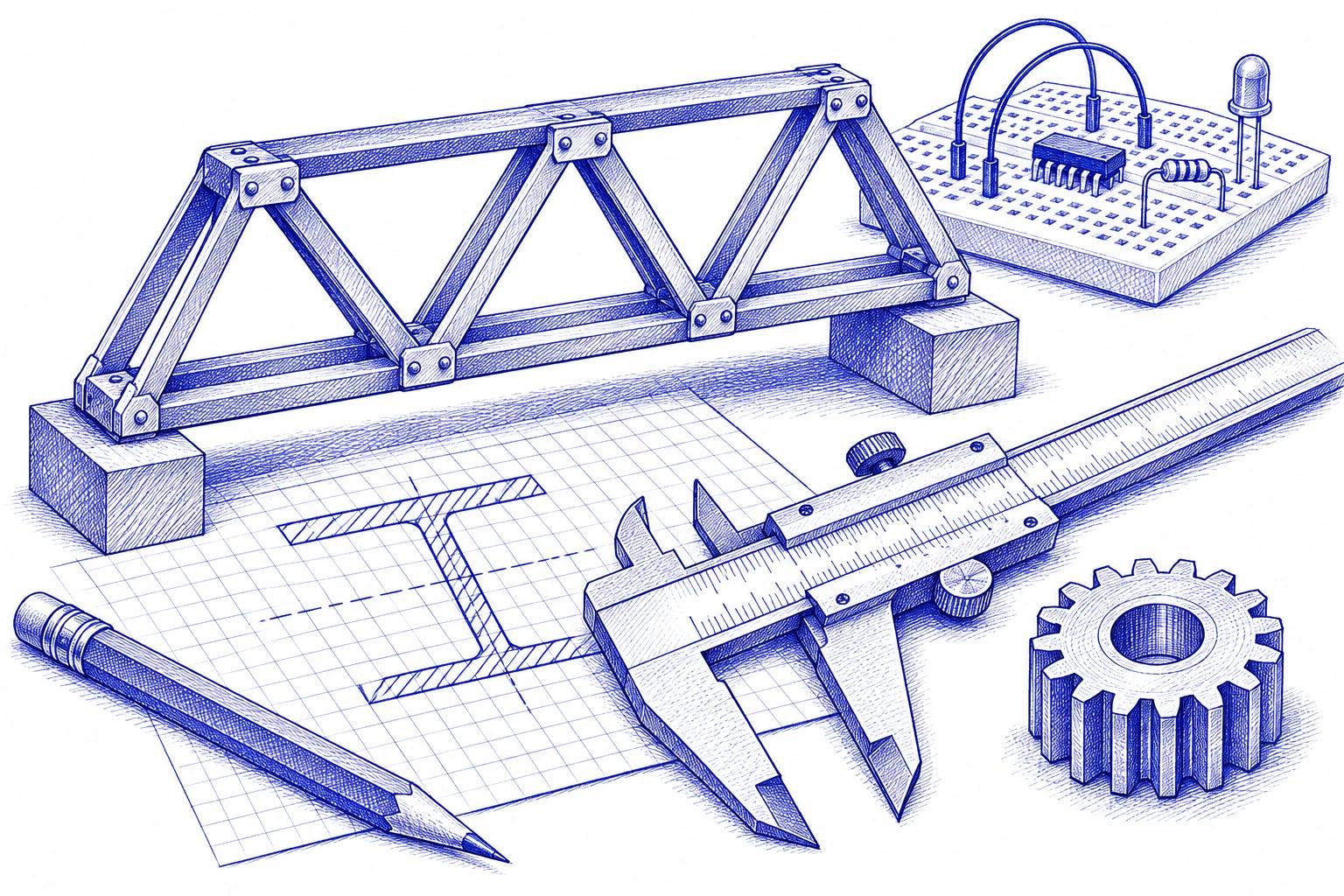
AI-generated ink illustration
Conceptual study artwork, not a photograph of teaching facilities.
Unidex · generated with ImageGen
Checked 2026-11-10
Symbolic first-year engineering illustration
Work experience
Engineering co-op: paid four-month work terms. Count and sequence vary by route.
UAlberta Engineering co-op structure and accreditationEntering average
Published approximate guidance: Published three-cycle historical guidance: Engineering: “mid 80s to low 90s”. These are the university’s literal approximate words, not exact numeric endpoints or a forecast for the next cycle.. Three admission cycles preceding the current page checked 2026-10-30; specific cycle years are not named. The central page states a general 70% floor across five programme-required subjects, with Grade 11 marks at least 60% and Grade 12 marks at least 50%. Individual programme requirements, capacity and actual offer conditions still govern. A broad faculty trend is not a major-specific admitted-average distribution.
Alberta current general minimum and literal three-cycle competitive trends October 2026
| Mon | Tue | Wed | Thu | Fri | Sat | Sun |
|---|---|---|---|---|---|---|
| 2 | 3 | 4 | ||||
| 5 | 6 | 7 | 8 | 9 | 10 | 11 |
| 12 | 13 | 14 | 15 | 16 | 17 | 18 |
| 19 | 20 | 21 | 22 | 23 | 24 | 25 |
| 26 | 27 | 28 | 29 | 30 | 31 |

2027 entry
Admission, entrance awards and residence applications open on the same date.
 Other deadline details
ApplyAlberta publishes NO deadline dates at all on its public pages. Its How to Apply page describes the process only: verbatim, "Now you will 'Start a New Application' at the institution of your choice. You will be directed to the institution's application portal where you will apply and pay any application fees", and "All application fees are paid directly to the institution you are applying to. Each institution has its own unique application fees". Deadlines must be read from each of Alberta's 26 publicly-funded institutions.
 Grade 12 English (ENG4U, ETS4U or EAE4U)
 MCV4UCalculus and Vectors MCV4U
 SCH4UChemistry SCH4U
 MHF4UAdvanced Functions MHF4U
 SPH4UPhysics SPH4U
Entry terms · Fall (September)
Engineering undergraduate entry published for Fall 2027. Deadlines vary by applicant group.
UAlberta Fall 2027 Engineering applications and documentsAlberta high-school applicants, 2026/27 published course requirements for this degree route
British Columbia high-school applicants, 2026/27 published course requirements for this degree route
Manitoba high-school applicants, 2026/27 published course requirements for this degree route
New Brunswick high-school applicants, 2026/27 published course requirements for this degree route
Newfoundland and Labrador high-school applicants, 2026/27 published course requirements for this degree route
Northwest Territories high-school applicants, 2026/27 published course requirements for this degree route
Nova Scotia high-school applicants, 2026/27 published course requirements for this degree route
Nunavut high-school applicants, 2026/27 published course requirements for this degree route
Ontario high-school applicants, 2026/27 published course requirements for this degree route
Prince Edward Island high-school applicants, 2026/27 published course requirements for this degree route
Quebec high-school applicants, 2026/27 published course requirements for this degree route
Saskatchewan high-school applicants, 2026/27 published course requirements for this degree route
Yukon high-school applicants, 2026/27 published course requirements for this degree route
International applicants high-school applicants, 2026/27 published course requirements for this degree route
Applicants directly from high school
Applicants with postsecondary coursework; each faculty controls actual entry conditions
The central page states a general 70% floor across five programme-required subjects, with Grade 11 marks at least 60% and Grade 12 marks at least 50%. Individual programme requirements, capacity and actual offer conditions still govern. A broad faculty trend is not a major-specific admitted-average distribution.
Alberta current general minimum and literal three-cycle competitive trendsAlberta current general minimum and literal three-cycle competitive trendsUpper-year placement is competitive. The Fall 2027 viewbook lists 15 discipline and option families with traditional and co-op routes, plus three co-op-only choices. Calendar plans distinguish study and work sequences within those choices.
BSc(Eng)

The plan covers chemical reactor analysis, thermodynamics and chemical engineering design.
The 2026–27 calendar shows a common first year followed by separate traditional and co-op plans. Select an upper-year route to see its academic and work terms. Your entry cohort’s calendar governs your requirements.
ENGL 199 and ENCMP 100 can swap terms. In the approved Honors Mathematics stream, MATH 117 replaces MATH 100.
CHEM 103Introductory University Chemistry I4.3 creditsAtoms and molecules, states of matter, chemistry of the elements.
Published note: Restricted to Engineering students only. Other students who take this course will receive 3 units.
Alberta 2026–27 current official course definitionENGG 100Success in Engineering1.1 creditsAn introduction to the Faculty of Engineering, the engineering profession, the skills required for academic success, and the fundamentals of leadership: study and life skills; time management and goal setting; interpersonal skills; career planning; engineering and society including elements of ethics, equity, concepts of sustainable development, environmental stewardship, and public safety.
Alberta 2026–27 current official course definitionENGG 130Engineering Mechanics4 creditsEquilibrium of planar systems. Analysis of statically determinate trusses and frames. Friction. Centroids and centres of gravity. Forces and moments in beams. Second moments of area.
Published note: Students in all sections of this course will write a common final examination. Corequisite: MATH 100.
Alberta 2026–27 current official course definitionENGL 199English for Engineering Students3 creditsThis course aims to develop the student's ability to provide effective written and oral information. It will focus on instruction in fundamental writing skills, including building effective sentences and paragraphs, and on learning to communicate clearly across a range of genres and media used in academic and professional contexts, including correspondence and presentations. Students will be introduced to the principles of information gathering, analysis, and citation.
Published note: Restricted to students in the Faculty of Engineering only.
Alberta 2026–27 current official course definitionMATH 100Calculus for Engineering I3.5 creditsReview of numbers, inequalities, functions, analytic geometry; limits, continuity; derivatives and applications, Taylor polynomials; log, exp, and inverse trig functions. Integration, fundamental theorem of calculus substitution, trapezoidal and Simpson's rules.
Alberta 2026–27 current official course definitionPHYS 130Wave Motion, Optics, and Sound3.8 creditsGeometrical optics, optical instruments, oscillations, waves, sound, interference, diffraction.
Alberta 2026–27 current official course definitionENGL 199 and ENCMP 100 can swap terms. In the approved Honors Mathematics stream, MATH 118 replaces MATH 101.
CHEM 105Introductory University Chemistry II3.8 creditsRates of reactions, thermodynamics and equilibrium, coordination chemistry, electrochemistry, modern applications of chemistry.
Published note: Restricted to Engineering students only. Other students who take this course will receive 3 units.
Alberta 2026–27 current official course definition ENCMP 100Computer Programming for Engineers3.8 credits
Fundamentals of computer programming with emphasis on solving engineering problems. Structure and syntax of computer programs, variables, data types, data structures, control structures, functions, input/output operations, debugging, software development process.
Alberta 2026–27 current official course definition ENGG 160Introduction to Engineering Design, Communication, and Profession2 credits
Fundamental design process and theory in a multidisciplinary context. Importance, in engineering design, of communications; team work; the engineering disciplines, career fields; professional responsibilities of the engineer including elements of ethics, equity, concepts of sustainable development and environmental stewardship, public and worker safety and health considerations including the context of the Alberta Occupational Health and Safety Act. Corequisite ENGL 199. This course is delivered in a blended format.
Alberta 2026–27 current official course definitionEN PH 131Mechanics4.3 creditsStudy motion, forces, energy and momentum, then apply them to rigid bodies.
UAlberta EN PH 131 · MechanicsMATH 101Calculus for Engineering II3.5 creditsArea between curves, techniques of integration. Applications of integration to planar areas and lengths, volumes and masses. First order ordinary differential equations: separable, linear, direction fields, Euler's method, applications. Infinite series, power series, Taylor expansions with remainder terms. Polar coordinates. Rectangular, spherical and cylindrical coordinates in 3-dimensional space. Parametric curves in the plane and space: graphing, arc length, curvature; normal binormal, tangent plane in 3- dimensional space. Volumes and surface areas of rotation.
Alberta 2026–27 current official course definition MATH 102Applied Linear Algebra3.5 credits
Vectors and matrices, solution of linear equations, equations of lines and planes, determinants, matrix algebra, orthogonality and applications (Gram-Schmidt), eigenvalues and eigenvectors and applications, complex numbers. Prerequisite or corequisite: MATH 100. Notes: (1) Credit can be obtained in at most one of MATH 102, 125, or 127. (2) Students in all sections of this course will write a common final examination. (3) Restricted to Engineering students. Non-Engineering students who take this course will receive 3 units.
Alberta 2026–27 current official course definitionChemical Engineering
Also take 1 complementary studies elective.
CH E 243Engineering Thermodynamics3.5 creditsCHEM 261Organic Chemistry I3 creditsCME 200Introduction to Chemical and Materials Engineering0.5 creditsCME 265Process Analysis4.5 creditsMATH 209Calculus for Engineering III3.5 creditsAlso take 1 impact of technology on society elective.
CH E 312Fluid Mechanics3.5 credits ECE 209Fundamentals of Electrical Engineering3.8 creditsMATH 201Differential Equations3.5 credits
 MAT E 202Materials Science II3.5 credits
 STAT 235Introductory Statistics for Engineering3.8 credits
Descriptive data analysis. Calculus of Probability. Binomial, multinomial, Poisson, normal, beta, exponential, gamma, hypergeometric, and Weibull distributions. Sampling distributions. Estimation, testing hypotheses, goodness-of-fit tests, and one-way analysis of variance. Linear correlation and regression. Sampling. Quality control. Use of a microcomputer software package for statistical analyses in engineering applications.
Alberta 2026–27 current official course definitionAlso take 1 program or technical elective.
CH E 314Heat Transfer3.5 creditsCH E 343Chemical Engineering Thermodynamics3.5 creditsCH E 351Chemical Engineering Laboratory3.5 creditsCH E 374Computational Methods in Engineering3.5 creditsChoose one: ENG M 310, ENG M 401.
CH E 316Separation Process4 creditsCH E 318Mass Transfer4 creditsCH E 345Chemical Reactor Analysis I3.5 creditsCH E 358Process Data Analytics and Machine Learning5 credits ENGG 404Engineering Safety and Risk Management-Leadership in Risk Management3.8 creditsENG M 310Engineering Economy3 credits
Choose one from this calendar group.
ENG M 401Financial Management for Engineers3 creditsChoose one from this calendar group.
Also take 1 complementary studies elective, 1 program or technical elective.
CH E 445Chemical Reactor Analysis II3.5 creditsCH E 446Process Dynamics and Control4 creditsCH E 464Chemical Engineering Design I4.5 creditsCME 481Colloquium I1 creditsAlso take 2 program or technical electives.
CH E 454Chemical Engineering Project Laboratory3 creditsCH E 465Chemical Engineering Design II6 creditsENGG 400The Practice of the Engineering Profession1 creditsChemical Engineering (co-op)
Also take 1 complementary studies elective.
CH E 243Engineering Thermodynamics3.5 creditsCME 200Introduction to Chemical and Materials Engineering0.5 creditsCHEM 261Organic Chemistry I3 creditsENGG 299Orientation to Cooperative Education1.5 creditsMAT E 202Materials Science II3.5 creditsMATH 209Calculus for Engineering III3.5 creditsAlso take 1 impact of technology on society elective.
CME 265Process Analysis4.5 creditsCH E 312Fluid Mechanics3.5 creditsECE 209Fundamentals of Electrical Engineering3.8 creditsMATH 201Differential Equations3.5 creditsSTAT 235Introductory Statistics for Engineering3.8 creditsDescriptive data analysis. Calculus of Probability. Binomial, multinomial, Poisson, normal, beta, exponential, gamma, hypergeometric, and Weibull distributions. Sampling distributions. Estimation, testing hypotheses, goodness-of-fit tests, and one-way analysis of variance. Linear correlation and regression. Sampling. Quality control. Use of a microcomputer software package for statistical analyses in engineering applications.
Alberta 2026–27 current official course definitionWKEXP 901Engineering Work Experience IEngineering co-op work term.
WKEXP 902Engineering Work Experience IIEngineering co-op work term.
Also take 1 program or technical elective.
CH E 314Heat Transfer3.5 creditsCH E 343Chemical Engineering Thermodynamics3.5 creditsCH E 351Chemical Engineering Laboratory3.5 creditsCH E 374Computational Methods in Engineering3.5 creditsChoose one: ENG M 310, ENG M 401.
CH E 316Separation Process4 creditsCH E 318Mass Transfer4 creditsCH E 345Chemical Reactor Analysis I3.5 creditsCH E 358Process Data Analytics and Machine Learning5 creditsENGG 404Engineering Safety and Risk Management-Leadership in Risk Management3.8 creditsENG M 310Engineering Economy3 creditsChoose one from this calendar group.
ENG M 401Financial Management for Engineers3 creditsChoose one from this calendar group.
WKEXP 903Engineering Work Experience IIIEngineering co-op work term.
Also take 1 program or technical elective, 1 complementary studies elective.
CH E 445Chemical Reactor Analysis II3.5 creditsCH E 446Process Dynamics and Control4 creditsCH E 464Chemical Engineering Design I4.5 creditsCME 481Colloquium I1 creditsWKEXP 904Engineering Work Experience IVEngineering co-op work term.
WKEXP 905Engineering Work Experience VEngineering co-op work term.
Also take 2 program or technical electives.
CH E 454Chemical Engineering Project Laboratory3 creditsCH E 465Chemical Engineering Design II6 creditsENGG 400The Practice of the Engineering Profession1 creditsChemical Engineering · Bioprocessing & Biomanufacturing
Also take 1 impact of technology on society elective, 1 complementary studies elective.
CH E 243Engineering Thermodynamics3.5 creditsCHEM 261Organic Chemistry I3 creditsCME 200Introduction to Chemical and Materials Engineering0.5 creditsCME 265Process Analysis4.5 creditsMATH 209Calculus for Engineering III3.5 credits BIOL 107Introduction to Cell Biology3 creditsCH E 312Fluid Mechanics3.5 creditsECE 209Fundamentals of Electrical Engineering3.8 creditsMATH 201Differential Equations3.5 creditsMAT E 202Materials Science II3.5 creditsSTAT 235Introductory Statistics for Engineering3.8 credits
Descriptive data analysis. Calculus of Probability. Binomial, multinomial, Poisson, normal, beta, exponential, gamma, hypergeometric, and Weibull distributions. Sampling distributions. Estimation, testing hypotheses, goodness-of-fit tests, and one-way analysis of variance. Linear correlation and regression. Sampling. Quality control. Use of a microcomputer software package for statistical analyses in engineering applications.
Alberta 2026–27 current official course definitionAlso take 1 program or technical elective.
CH E 314Heat Transfer3.5 creditsCH E 343Chemical Engineering Thermodynamics3.5 creditsCH E 351Chemical Engineering Laboratory3.5 creditsCH E 374Computational Methods in Engineering3.5 creditsChoose one: ENG M 310, ENG M 401.
CH E 316Separation Process4 creditsCH E 318Mass Transfer4 creditsCH E 345Chemical Reactor Analysis I3.5 creditsCH E 358Process Data Analytics and Machine Learning5 creditsENGG 404Engineering Safety and Risk Management-Leadership in Risk Management3.8 creditsENG M 310Engineering Economy3 creditsChoose one from this calendar group.
ENG M 401Financial Management for Engineers3 creditsChoose one from this calendar group.
Also take 1 complementary studies elective, 1 program or technical elective.
CH E 445Chemical Reactor Analysis II3.5 creditsCH E 446Process Dynamics and Control4 creditsCH E 464Chemical Engineering Design I4.5 creditsCME 481Colloquium I1 creditsCH E 454Chemical Engineering Project Laboratory3 creditsCH E 465Chemical Engineering Design II6 creditsCH E 484Introduction to Biochemical Engineering3.5 creditsCH E 581Biocataysis and Bioreactors3.5 creditsENGG 400The Practice of the Engineering Profession1 creditsChemical Engineering · Bioprocessing & Biomanufacturing (co-op)
Also take 1 impact of technology on society elective, 1 complementary studies elective.
CH E 243Engineering Thermodynamics3.5 creditsCHEM 261Organic Chemistry I3 creditsCME 200Introduction to Chemical and Materials Engineering0.5 creditsENGG 299Orientation to Cooperative Education1.5 creditsMAT E 202Materials Science II3.5 creditsMATH 209Calculus for Engineering III3.5 creditsBIOL 107Introduction to Cell Biology3 creditsCH E 312Fluid Mechanics3.5 creditsCME 265Process Analysis4.5 creditsECE 209Fundamentals of Electrical Engineering3.8 creditsMATH 201Differential Equations3.5 creditsSTAT 235Introductory Statistics for Engineering3.8 creditsDescriptive data analysis. Calculus of Probability. Binomial, multinomial, Poisson, normal, beta, exponential, gamma, hypergeometric, and Weibull distributions. Sampling distributions. Estimation, testing hypotheses, goodness-of-fit tests, and one-way analysis of variance. Linear correlation and regression. Sampling. Quality control. Use of a microcomputer software package for statistical analyses in engineering applications.
Alberta 2026–27 current official course definitionWKEXP 901Engineering Work Experience IEngineering co-op work term.
WKEXP 902Engineering Work Experience IIEngineering co-op work term.
Also take 1 program or technical elective.
CH E 314Heat Transfer3.5 creditsCH E 343Chemical Engineering Thermodynamics3.5 creditsCH E 351Chemical Engineering Laboratory3.5 creditsCH E 374Computational Methods in Engineering3.5 creditsChoose one: ENG M 310, ENG M 401.
CH E 316Separation Process4 creditsCH E 318Mass Transfer4 creditsCH E 345Chemical Reactor Analysis I3.5 creditsCH E 358Process Data Analytics and Machine Learning5 creditsENGG 404Engineering Safety and Risk Management-Leadership in Risk Management3.8 creditsENG M 310Engineering Economy3 creditsChoose one from this calendar group.
ENG M 401Financial Management for Engineers3 creditsChoose one from this calendar group.
WKEXP 903Engineering Work Experience IIIEngineering co-op work term.
Also take 1 program or technical elective, 1 complementary studies elective.
CH E 445Chemical Reactor Analysis II3.5 creditsCH E 446Process Dynamics and Control4 creditsCH E 464Chemical Engineering Design I4.5 creditsCME 481Colloquium I1 creditsWKEXP 904Engineering Work Experience IVEngineering co-op work term.
WKEXP 905Engineering Work Experience VEngineering co-op work term.
CH E 454Chemical Engineering Project Laboratory3 creditsCH E 465Chemical Engineering Design II6 creditsCH E 484Introduction to Biochemical Engineering3.5 creditsCH E 581Biocataysis and Bioreactors3.5 creditsENGG 400The Practice of the Engineering Profession1 creditsChemical Engineering · Clean Energy and Sustainable Process Systems
CH E 243Engineering Thermodynamics3.5 creditsCHEM 261Organic Chemistry I3 creditsCME 200Introduction to Chemical and Materials Engineering0.5 creditsCME 265Process Analysis4.5 creditsEAS 208Introduction to Global Change3 creditsMATH 209Calculus for Engineering III3.5 creditsAlso take 1 impact of technology on society elective.
CH E 312Fluid Mechanics3.5 creditsECE 209Fundamentals of Electrical Engineering3.8 creditsMAT E 202Materials Science II3.5 creditsMATH 201Differential Equations3.5 creditsSTAT 235Introductory Statistics for Engineering3.8 creditsDescriptive data analysis. Calculus of Probability. Binomial, multinomial, Poisson, normal, beta, exponential, gamma, hypergeometric, and Weibull distributions. Sampling distributions. Estimation, testing hypotheses, goodness-of-fit tests, and one-way analysis of variance. Linear correlation and regression. Sampling. Quality control. Use of a microcomputer software package for statistical analyses in engineering applications.
Alberta 2026–27 current official course definitionChoose one: ENG M 310, ENG M 401. Also take 1 complementary studies elective.
CH E 314Heat Transfer3.5 creditsCH E 343Chemical Engineering Thermodynamics3.5 creditsCH E 351Chemical Engineering Laboratory3.5 creditsCH E 374Computational Methods in Engineering3.5 creditsENG M 310Engineering Economy3 creditsChoose one from this calendar group.
ENG M 401Financial Management for Engineers3 creditsChoose one from this calendar group.
Eligible choices for the required elective slots: CH E 544, CH E 545, CME 458, CME 459, MAT E 491. Also take 2 program or technical electives.
CH E 316Separation Process4 creditsCH E 318Mass Transfer4 creditsCH E 345Chemical Reactor Analysis I3.5 creditsCH E 358Process Data Analytics and Machine Learning5 creditsCH E 544Conversion of Biomass to Fuels and Chemicals3.5 creditsApproved elective choice for this term.
CH E 545Chemical Engineering For Circular Economy3.5 creditsApproved elective choice for this term.
CME 458Special Projects in Chemical and Materials Engineering I3.5 creditsApproved elective choice for this term.
CME 459Special Projects in Chemical and Materials Engineering II3.5 creditsApproved elective choice for this term.
MAT E 491Properties and Physics of Functional Materials3.5 creditsApproved elective choice for this term.
Also take 1 complementary studies elective.
CH E 445Chemical Reactor Analysis II3.5 creditsCH E 446Process Dynamics and Control4 creditsCH E 464Chemical Engineering Design I4.5 creditsCME 481Colloquium I1 creditsENGG 404Engineering Safety and Risk Management-Leadership in Risk Management3.8 creditsCH E 454Chemical Engineering Project Laboratory3 creditsCH E 465Chemical Engineering Design II6 creditsCH E 541Analysis of Chemical and Energy Systems3.5 creditsCH E 542Electrochemical Energy Storage and Transformation3.5 creditsENGG 400The Practice of the Engineering Profession1 creditsChemical Engineering · Clean Energy and Sustainable Process Systems (co-op)
Also take 1 complementary studies elective.
CH E 243Engineering Thermodynamics3.5 creditsCME 200Introduction to Chemical and Materials Engineering0.5 creditsCHEM 261Organic Chemistry I3 creditsEAS 208Introduction to Global Change3 creditsENGG 299Orientation to Cooperative Education1.5 creditsMAT E 202Materials Science II3.5 creditsMATH 209Calculus for Engineering III3.5 creditsAlso take 1 impact of technology on society elective.
CH E 312Fluid Mechanics3.5 creditsCME 265Process Analysis4.5 creditsECE 209Fundamentals of Electrical Engineering3.8 creditsMATH 201Differential Equations3.5 creditsSTAT 235Introductory Statistics for Engineering3.8 creditsDescriptive data analysis. Calculus of Probability. Binomial, multinomial, Poisson, normal, beta, exponential, gamma, hypergeometric, and Weibull distributions. Sampling distributions. Estimation, testing hypotheses, goodness-of-fit tests, and one-way analysis of variance. Linear correlation and regression. Sampling. Quality control. Use of a microcomputer software package for statistical analyses in engineering applications.
Alberta 2026–27 current official course definitionWKEXP 901Engineering Work Experience IEngineering co-op work term.
WKEXP 902Engineering Work Experience IIEngineering co-op work term.
Also take 1 complementary studies elective.
CH E 314Heat Transfer3.5 creditsCH E 343Chemical Engineering Thermodynamics3.5 creditsCH E 351Chemical Engineering Laboratory3.5 creditsCH E 374Computational Methods in Engineering3.5 creditsChoose one: ENG M 310, ENG M 401.
CH E 316Separation Process4 creditsCH E 318Mass Transfer4 creditsCH E 345Chemical Reactor Analysis I3.5 creditsCH E 358Process Data Analytics and Machine Learning5 creditsENGG 404Engineering Safety and Risk Management-Leadership in Risk Management3.8 creditsENG M 310Engineering Economy3 creditsChoose one from this calendar group.
ENG M 401Financial Management for Engineers3 creditsChoose one from this calendar group.
WKEXP 903Engineering Work Experience IIIEngineering co-op work term.
Eligible choices for the required elective slots: CH E 544, CH E 545, CME 458, CME 459, MAT E 491. Also take 2 program or technical electives.
CH E 445Chemical Reactor Analysis II3.5 creditsCH E 446Process Dynamics and Control4 creditsCH E 464Chemical Engineering Design I4.5 creditsCME 481Colloquium I1 creditsCH E 544Conversion of Biomass to Fuels and Chemicals3.5 creditsApproved elective choice for this term.
CH E 545Chemical Engineering For Circular Economy3.5 creditsApproved elective choice for this term.
CME 458Special Projects in Chemical and Materials Engineering I3.5 creditsApproved elective choice for this term.
CME 459Special Projects in Chemical and Materials Engineering II3.5 creditsApproved elective choice for this term.
MAT E 491Properties and Physics of Functional Materials3.5 creditsApproved elective choice for this term.
WKEXP 904Engineering Work Experience IVEngineering co-op work term.
WKEXP 905Engineering Work Experience VEngineering co-op work term.
CH E 454Chemical Engineering Project Laboratory3 creditsCH E 465Chemical Engineering Design II6 creditsCH E 541Analysis of Chemical and Energy Systems3.5 creditsCH E 542Electrochemical Energy Storage and Transformation3.5 creditsENGG 400The Practice of the Engineering Profession1 creditsChemical Engineering · Computer Process Control
Also take 1 complementary studies elective.
CH E 243Engineering Thermodynamics3.5 creditsCHEM 261Organic Chemistry I3 creditsCME 200Introduction to Chemical and Materials Engineering0.5 creditsECE 202Electrical Circuits I4.3 creditsECE 210Introduction to Digital Logic Design3.8 creditsMATH 209Calculus for Engineering III3.5 creditsAlso take 1 complementary studies elective.
CME 265Process Analysis4.5 creditsCH E 312Fluid Mechanics3.5 creditsMAT E 202Materials Science II3.5 creditsMATH 201Differential Equations3.5 creditsSTAT 235Introductory Statistics for Engineering3.8 creditsDescriptive data analysis. Calculus of Probability. Binomial, multinomial, Poisson, normal, beta, exponential, gamma, hypergeometric, and Weibull distributions. Sampling distributions. Estimation, testing hypotheses, goodness-of-fit tests, and one-way analysis of variance. Linear correlation and regression. Sampling. Quality control. Use of a microcomputer software package for statistical analyses in engineering applications.
Alberta 2026–27 current official course definitionAlso take 1 impact of technology on society elective.
CH E 314Heat Transfer3.5 creditsCH E 343Chemical Engineering Thermodynamics3.5 creditsCH E 351Chemical Engineering Laboratory3.5 creditsCH E 374Computational Methods in Engineering3.5 creditsENGG 404Engineering Safety and Risk Management-Leadership in Risk Management3.8 creditsChoose one: ENG M 310, ENG M 401.
CH E 316Separation Process4 creditsCH E 318Mass Transfer4 creditsCH E 345Chemical Reactor Analysis I3.5 creditsCH E 358Process Data Analytics and Machine Learning5 creditsCH E 574Process Optimization4 creditsENG M 310Engineering Economy3 creditsChoose one from this calendar group.
ENG M 401Financial Management for Engineers3 creditsChoose one from this calendar group.
Also take 2 program or technical electives.
CH E 446Process Dynamics and Control4 creditsCH E 464Chemical Engineering Design I4.5 creditsCME 481Colloquium I1 creditsCH E 454Chemical Engineering Project Laboratory3 creditsCH E 465Chemical Engineering Design II6 creditsCH E 573Digital Signal Processing for Chemical Engineers3.8 creditsCH E 576Intermediate Process Control3.8 creditsENGG 400The Practice of the Engineering Profession1 creditsChemical Engineering · Computer Process Control (co-op)
Also take 1 complementary studies elective.
CH E 243Engineering Thermodynamics3.5 creditsCHEM 261Organic Chemistry I3 creditsCME 200Introduction to Chemical and Materials Engineering0.5 creditsECE 202Electrical Circuits I4.3 creditsECE 210Introduction to Digital Logic Design3.8 creditsENGG 299Orientation to Cooperative Education1.5 creditsMATH 209Calculus for Engineering III3.5 creditsAlso take 1 complementary studies elective.
CH E 312Fluid Mechanics3.5 creditsCME 265Process Analysis4.5 creditsMAT E 202Materials Science II3.5 creditsMATH 201Differential Equations3.5 creditsSTAT 235Introductory Statistics for Engineering3.8 creditsDescriptive data analysis. Calculus of Probability. Binomial, multinomial, Poisson, normal, beta, exponential, gamma, hypergeometric, and Weibull distributions. Sampling distributions. Estimation, testing hypotheses, goodness-of-fit tests, and one-way analysis of variance. Linear correlation and regression. Sampling. Quality control. Use of a microcomputer software package for statistical analyses in engineering applications.
Alberta 2026–27 current official course definitionWKEXP 901Engineering Work Experience IEngineering co-op work term.
WKEXP 902Engineering Work Experience IIEngineering co-op work term.
Also take 1 program or technical elective, 1 impact of technology on society elective.
CH E 314Heat Transfer3.5 creditsCH E 343Chemical Engineering Thermodynamics3.5 creditsCH E 351Chemical Engineering Laboratory3.5 creditsCH E 374Computational Methods in Engineering3.5 creditsChoose one: ENG M 310, ENG M 401.
CH E 316Separation Process4 creditsCH E 318Mass Transfer4 creditsCH E 345Chemical Reactor Analysis I3.5 creditsCH E 358Process Data Analytics and Machine Learning5 creditsENGG 404Engineering Safety and Risk Management-Leadership in Risk Management3.8 creditsENG M 310Engineering Economy3 creditsChoose one from this calendar group.
ENG M 401Financial Management for Engineers3 creditsChoose one from this calendar group.
WKEXP 903Engineering Work Experience IIIEngineering co-op work term.
Also take 1 program or technical elective.
CH E 446Process Dynamics and Control4 creditsCH E 464Chemical Engineering Design I4.5 creditsCH E 574Process Optimization4 creditsCME 481Colloquium I1 creditsWKEXP 904Engineering Work Experience IVEngineering co-op work term.
WKEXP 905Engineering Work Experience VEngineering co-op work term.
CH E 454Chemical Engineering Project Laboratory3 creditsCH E 465Chemical Engineering Design II6 creditsCH E 573Digital Signal Processing for Chemical Engineers3.8 creditsCH E 576Intermediate Process Control3.8 creditsENGG 400The Practice of the Engineering Profession1 creditsCivil Engineering
CIV E 265Engineering Drawing and Computer Graphics3.5 creditsCIV E 270Mechanics of Deformable Bodies I4.5 credits EAS 210Engineering Earth Science4.5 creditsMAT E 202Materials Science II3.5 creditsMATH 209Calculus for Engineering III3.5 creditsCIV E 221Environmental Engineering Fundamentals3.8 creditsCIV E 240Technical Communications2 credits
 CIV E 250Plane Surveying4.5 creditsCIV E 295Numerical Methods for Civil Engineers4 creditsMATH 201Differential Equations3.5 creditsSTAT 235Introductory Statistics for Engineering3.8 credits
Descriptive data analysis. Calculus of Probability. Binomial, multinomial, Poisson, normal, beta, exponential, gamma, hypergeometric, and Weibull distributions. Sampling distributions. Estimation, testing hypotheses, goodness-of-fit tests, and one-way analysis of variance. Linear correlation and regression. Sampling. Quality control. Use of a microcomputer software package for statistical analyses in engineering applications.
Alberta 2026–27 current official course definitionAlso take 1 complementary studies elective.
CIV E 251Survey School1.5 creditsCIV E 330Introduction to Fluid Mechanics3.5 creditsCIV E 372Structural Analysis I4 creditsCIV E 391Civil Engineering Materials4.5 creditsCIV E 395Civil Engineering Analysis3.5 creditsCIV E 398Introduction to Continuum Mechanics3.5 creditsCIV E 303Project Management3.8 creditsCIV E 315Transportation Engineering4 creditsCIV E 321Principles of Environmental Modeling and Risk3.8 creditsCIV E 331Applied Hydraulics3.8 creditsCIV E 374Structural Design I4.5 creditsCIV E 381Soil Mechanics4.5 creditsChoose one: ECE 209, MEC E 250, CH E 243. Also take 2 program or technical electives.
CIV E 460Civil Engineering Design Project I3.8 creditsENGG 404Engineering Safety and Risk Management-Leadership in Risk Management3.8 creditsECE 209Fundamentals of Electrical Engineering3.8 creditsChoose one from this calendar group.
MEC E 250Engineering Mechanics II3.5 creditsChoose one from this calendar group.
CH E 243Engineering Thermodynamics3.5 creditsChoose one from this calendar group.
Choose one: ENG M 310, ENG M 401. Also take 1 program or technical elective, 1 impact of technology on society elective.
CIV E 461Civil Engineering Design Project II4.5 creditsENGG 400The Practice of the Engineering Profession1 credits ENGG 420Engineering Law3 creditsENG M 310Engineering Economy3 credits
Choose one from this calendar group.
ENG M 401Financial Management for Engineers3 creditsChoose one from this calendar group.
Civil Engineering (co-op)
CIV E 265Engineering Drawing and Computer Graphics3.5 creditsCIV E 270Mechanics of Deformable Bodies I4.5 creditsENGG 299Orientation to Cooperative Education1.5 creditsEAS 210Engineering Earth Science4.5 creditsMAT E 202Materials Science II3.5 creditsMATH 209Calculus for Engineering III3.5 creditsThis option runs in the spring session.
CIV E 221Environmental Engineering Fundamentals3.8 creditsCIV E 240Technical Communications2 creditsCIV E 250Plane Surveying4.5 creditsCIV E 251Survey School1.5 creditsCIV E 295Numerical Methods for Civil Engineers4 creditsMATH 201Differential Equations3.5 creditsSTAT 235Introductory Statistics for Engineering3.8 creditsDescriptive data analysis. Calculus of Probability. Binomial, multinomial, Poisson, normal, beta, exponential, gamma, hypergeometric, and Weibull distributions. Sampling distributions. Estimation, testing hypotheses, goodness-of-fit tests, and one-way analysis of variance. Linear correlation and regression. Sampling. Quality control. Use of a microcomputer software package for statistical analyses in engineering applications.
Alberta 2026–27 current official course definitionWKEXP 901Engineering Work Experience IEngineering co-op work term.
WKEXP 902Engineering Work Experience IIEngineering co-op work term.
CIV E 303Project Management3.8 creditsCIV E 315Transportation Engineering4 creditsCIV E 321Principles of Environmental Modeling and Risk3.8 creditsCIV E 330Introduction to Fluid Mechanics3.5 creditsCIV E 372Structural Analysis I4 creditsCIV E 395Civil Engineering Analysis3.5 creditsWKEXP 903Engineering Work Experience IIIEngineering co-op work term.
Also take 1 complementary studies elective.
CIV E 331Applied Hydraulics3.8 creditsCIV E 374Structural Design I4.5 creditsCIV E 381Soil Mechanics4.5 creditsCIV E 391Civil Engineering Materials4.5 creditsCIV E 398Introduction to Continuum Mechanics3.5 creditsWKEXP 904Engineering Work Experience IVEngineering co-op work term.
WKEXP 905Engineering Work Experience VEngineering co-op work term.
Choose one: ECE 209, MEC E 250, CH E 243. Also take 2 program or technical electives.
CIV E 460Civil Engineering Design Project I3.8 creditsENGG 404Engineering Safety and Risk Management-Leadership in Risk Management3.8 creditsECE 209Fundamentals of Electrical Engineering3.8 creditsChoose one from this calendar group.
MEC E 250Engineering Mechanics II3.5 creditsChoose one from this calendar group.
CH E 243Engineering Thermodynamics3.5 creditsChoose one from this calendar group.
Choose one: ENG M 310, ENG M 401. Also take 1 program or technical elective, 1 impact of technology on society elective.
ENGG 400The Practice of the Engineering Profession1 creditsCIV E 461Civil Engineering Design Project II4.5 creditsENGG 420Engineering Law3 creditsENG M 310Engineering Economy3 creditsChoose one from this calendar group.
ENG M 401Financial Management for Engineers3 creditsChoose one from this calendar group.
Civil Engineering · Environmental Engineering
CIV E 265Engineering Drawing and Computer Graphics3.5 creditsCIV E 270Mechanics of Deformable Bodies I4.5 creditsEAS 210Engineering Earth Science4.5 creditsENV E 220Environmental Chemistry for Engineering3.8 creditsMATH 209Calculus for Engineering III3.5 creditsCIV E 240Technical Communications2 creditsCIV E 250Plane Surveying4.5 creditsCIV E 295Numerical Methods for Civil Engineers4 creditsENV E 251Properties of Environmental Engineering Materials3.8 creditsMATH 201Differential Equations3.5 creditsSTAT 235Introductory Statistics for Engineering3.8 creditsDescriptive data analysis. Calculus of Probability. Binomial, multinomial, Poisson, normal, beta, exponential, gamma, hypergeometric, and Weibull distributions. Sampling distributions. Estimation, testing hypotheses, goodness-of-fit tests, and one-way analysis of variance. Linear correlation and regression. Sampling. Quality control. Use of a microcomputer software package for statistical analyses in engineering applications.
Alberta 2026–27 current official course definitionCH E 243Engineering Thermodynamics3.5 creditsCIV E 251Survey School1.5 creditsCIV E 330Introduction to Fluid Mechanics3.5 creditsCIV E 372Structural Analysis I4 creditsCIV E 395Civil Engineering Analysis3.5 creditsENV E 324Biological Processes3.8 creditsENV E 326Environmental Site Assessment3 creditsAlso take 1 complementary studies elective.
CIV E 331Applied Hydraulics3.8 creditsCIV E 381Soil Mechanics4.5 creditsENV E 302Environmental Impact Assessment2.5 creditsENV E 325Chemical and Physical Processes3.8 creditsENGG 404Engineering Safety and Risk Management-Leadership in Risk Management3.8 creditsChoose one: CIV E 524, CIV E 525, CIV E 526, ENV E 400.
CIV E 374Structural Design I4.5 creditsENV E 320Environmental Hydrology3.8 creditsENV E 421Municipal Systems3.8 creditsENV E 423Principles of Air Quality Management and Control3 creditsENV E 432Solid Waste Management3 creditsCIV E 524Environmental Biotechnology3 creditsChoose one from this calendar group.
CIV E 525Environmental Water Quality Management3 creditsChoose one from this calendar group.
CIV E 526Soil Remediation3 creditsChoose one from this calendar group.
ENV E 400Advanced Environmental Engineering I3 creditsChoose one from this calendar group.
Choose one: ECE 209, MAT E 202, MEC E 250. Choose one: ENG M 310, ENG M 401. Also take 1 impact of technology on society elective.
ENGG 400The Practice of the Engineering Profession1 creditsENV E 434Environmental Geotechnics3 creditsENV E 440Facility Design4.5 creditsLAW 399Introduction to Environmental Law3 creditsECE 209Fundamentals of Electrical Engineering3.8 creditsChoose one from this calendar group.
MAT E 202Materials Science II3.5 creditsChoose one from this calendar group.
MEC E 250Engineering Mechanics II3.5 creditsChoose one from this calendar group.
ENG M 310Engineering Economy3 creditsChoose one from this calendar group.
ENG M 401Financial Management for Engineers3 creditsChoose one from this calendar group.
Civil Engineering · Environmental Engineering (co-op)
CIV E 265Engineering Drawing and Computer Graphics3.5 creditsCIV E 270Mechanics of Deformable Bodies I4.5 creditsENGG 299Orientation to Cooperative Education1.5 creditsENV E 220Environmental Chemistry for Engineering3.8 creditsEAS 210Engineering Earth Science4.5 creditsMATH 209Calculus for Engineering III3.5 creditsThis option runs in the spring session.
CIV E 240Technical Communications2 creditsCIV E 250Plane Surveying4.5 creditsCIV E 251Survey School1.5 creditsCIV E 295Numerical Methods for Civil Engineers4 creditsENV E 251Properties of Environmental Engineering Materials3.8 creditsMATH 201Differential Equations3.5 creditsSTAT 235Introductory Statistics for Engineering3.8 creditsDescriptive data analysis. Calculus of Probability. Binomial, multinomial, Poisson, normal, beta, exponential, gamma, hypergeometric, and Weibull distributions. Sampling distributions. Estimation, testing hypotheses, goodness-of-fit tests, and one-way analysis of variance. Linear correlation and regression. Sampling. Quality control. Use of a microcomputer software package for statistical analyses in engineering applications.
Alberta 2026–27 current official course definitionWKEXP 901Engineering Work Experience IEngineering co-op work term.
WKEXP 902Engineering Work Experience IIEngineering co-op work term.
Also take 1 complementary studies elective.
CIV E 330Introduction to Fluid Mechanics3.5 creditsCIV E 395Civil Engineering Analysis3.5 creditsENV E 302Environmental Impact Assessment2.5 creditsENV E 325Chemical and Physical Processes3.8 creditsENGG 404Engineering Safety and Risk Management-Leadership in Risk Management3.8 creditsWKEXP 903Engineering Work Experience IIIEngineering co-op work term.
CH E 243Engineering Thermodynamics3.5 creditsCIV E 331Applied Hydraulics3.8 creditsCIV E 372Structural Analysis I4 creditsCIV E 381Soil Mechanics4.5 creditsENV E 324Biological Processes3.8 creditsENV E 326Environmental Site Assessment3 creditsWKEXP 904Engineering Work Experience IVEngineering co-op work term.
WKEXP 905Engineering Work Experience VEngineering co-op work term.
Choose one: CIV E 524, CIV E 525, CIV E 526, ENV E 400.
CIV E 374Structural Design I4.5 creditsENV E 320Environmental Hydrology3.8 creditsENV E 421Municipal Systems3.8 creditsENV E 423Principles of Air Quality Management and Control3 creditsENV E 432Solid Waste Management3 creditsCIV E 524Environmental Biotechnology3 creditsChoose one from this calendar group.
CIV E 525Environmental Water Quality Management3 creditsChoose one from this calendar group.
CIV E 526Soil Remediation3 creditsChoose one from this calendar group.
ENV E 400Advanced Environmental Engineering I3 creditsChoose one from this calendar group.
Choose one: ECE 209, MAT E 202, MEC E 250. Choose one: ENG M 310, ENG M 401. Also take 1 impact of technology on society elective.
ENGG 400The Practice of the Engineering Profession1 creditsENV E 434Environmental Geotechnics3 creditsENV E 440Facility Design4.5 creditsLAW 399Introduction to Environmental Law3 creditsECE 209Fundamentals of Electrical Engineering3.8 creditsChoose one from this calendar group.
MAT E 202Materials Science II3.5 creditsChoose one from this calendar group.
MEC E 250Engineering Mechanics II3.5 creditsChoose one from this calendar group.
ENG M 310Engineering Economy3 creditsChoose one from this calendar group.
ENG M 401Financial Management for Engineers3 creditsChoose one from this calendar group.
Computer Engineering
Also take 1 complementary studies elective.
CMPUT 274Accelerated Introduction to the Foundations of Computation I3 creditsUses Python and Linux to practice procedural programming, sorting and searching, and foundational data structures. The studio combines lectures and labs. Math 30-1 is required and prior programming is recommended.
University of Alberta CMPUT 274 course catalogueECE 202Electrical Circuits I4.3 creditsECE 210Introduction to Digital Logic Design3.8 creditsMATH 201Differential Equations3.5 creditsMATH 209Calculus for Engineering III3.5 creditsCMPUT 272Formal Systems and Logic in Computing Science3 creditsAn introduction to the tools of set theory, logic, and induction, and their use in the practice of reasoning about algorithms and programs. Basic set theory; the notion of a function; counting; propositional and predicate logic and their proof systems; inductive definitions and proofs by induction; program specification and correctness.
Alberta 2026–27 current official course definitionCMPUT 275Accelerated Introduction to the Foundations of Computation II3 creditsUses C++ to introduce object-oriented programming and algorithms such as shortest paths, divide-and-conquer and dynamic programming. CMPUT 274 is the prerequisite.
University of Alberta CMPUT 275 course catalogueECE 203Electrical Circuits II4.3 creditsECE 212Introduction to Microprocessors3.8 creditsECE 240Continuous Time Signals and Systems3.5 creditsPHYS 230Electricity and Magnetism3.8 creditsChoose one: ENG M 310, ENG M 401. Also take 1 Group I technical elective.
ECE 302Electronic Devices4.3 creditsECE 311Computer Organization and Architecture3 creditsECE 325Object-Oriented Software Design3.8 creditsECE 340Discrete Time Signals and Systems3.8 creditsENG M 310Engineering Economy3 creditsChoose one from this calendar group.
ENG M 401Financial Management for Engineers3 creditsChoose one from this calendar group.
Also take 1 complementary studies elective, 1 Group II technical elective, 1 impact of technology on society elective.
CMPUT 291Introduction to File and Database Management3 creditsBasic concepts in computer data organization and information processing; entity-relationship model; relational model; SQL and other relational query languages; storage architecture; physical organization of data; access methods for relational data. Programming experience (e.g., Python) is required for the course project.
Alberta 2026–27 current official course definitionCMPUT 379Operating System Concepts3 creditsIntroduction to the structure, components, and concepts behind modern general-purpose operating systems. Processes: process state transitions; operations on processes; interrupt processing; multiprocessor considerations; resource allocation; synchronization; critical sections and events; semaphores; deadlock: avoidance, detection, and recovery; memory management; virtual memory; paging and segmentation; page replacement strategies; working sets; demand paging; process scheduling; scheduling algorithms; file system functions; file organization; space allocation; virtual machines.
Alberta 2026–27 current official course definitionECE 315Computer Interfacing3.8 creditsAlso take 1 Group II technical elective.
CMPUT 301Introduction to Software Engineering3 creditsObject-oriented design and analysis, with interactive applications as the primary example. Topics include: software process; revision control; Unified Modeling Language (UML); requirements; software architecture, design patterns, frameworks, design guidelines; unit testing; refactoring; software tools.
Alberta 2026–27 current official course definitionECE 304Digital Electronics4.3 creditsECE 342Probability for Electrical and Computer Engineers3.5 creditsECE 410Advanced Digital Logic Design3.8 creditsENGG 404Engineering Safety and Risk Management-Leadership in Risk Management3.8 creditsAlso take 1 Group I technical elective, 1 Group II technical elective.
ECE 420Parallel and Distributed Programming3.8 creditsECE 487Data Communication Networks3 creditsECE 492Computer Engineering Design Project4 creditsENGG 400The Practice of the Engineering Profession1 creditsComputer Engineering (co-op)
CMPUT 274Accelerated Introduction to the Foundations of Computation I3 creditsUses Python and Linux to practice procedural programming, sorting and searching, and foundational data structures. The studio combines lectures and labs. Math 30-1 is required and prior programming is recommended.
University of Alberta CMPUT 274 course catalogueECE 202Electrical Circuits I4.3 creditsECE 210Introduction to Digital Logic Design3.8 creditsENGG 299Orientation to Cooperative Education1.5 creditsMATH 201Differential Equations3.5 creditsMATH 209Calculus for Engineering III3.5 creditsCMPUT 272Formal Systems and Logic in Computing Science3 creditsAn introduction to the tools of set theory, logic, and induction, and their use in the practice of reasoning about algorithms and programs. Basic set theory; the notion of a function; counting; propositional and predicate logic and their proof systems; inductive definitions and proofs by induction; program specification and correctness.
Alberta 2026–27 current official course definitionCMPUT 275Accelerated Introduction to the Foundations of Computation II3 creditsUses C++ to introduce object-oriented programming and algorithms such as shortest paths, divide-and-conquer and dynamic programming. CMPUT 274 is the prerequisite.
University of Alberta CMPUT 275 course catalogueECE 203Electrical Circuits II4.3 creditsECE 212Introduction to Microprocessors3.8 creditsECE 240Continuous Time Signals and Systems3.5 creditsPHYS 230Electricity and Magnetism3.8 creditsWKEXP 901Engineering Work Experience IEngineering co-op work term.
Also take 1 Group I technical elective.
CMPUT 291Introduction to File and Database Management3 creditsBasic concepts in computer data organization and information processing; entity-relationship model; relational model; SQL and other relational query languages; storage architecture; physical organization of data; access methods for relational data. Programming experience (e.g., Python) is required for the course project.
Alberta 2026–27 current official course definitionECE 302Electronic Devices4.3 creditsECE 311Computer Organization and Architecture3 creditsECE 325Object-Oriented Software Design3.8 creditsECE 340Discrete Time Signals and Systems3.8 creditsWKEXP 902Engineering Work Experience IIEngineering co-op work term.
WKEXP 903Engineering Work Experience IIIEngineering co-op work term.
Also take 1 complementary studies elective, 1 Group II technical elective.
CMPUT 379Operating System Concepts3 creditsIntroduction to the structure, components, and concepts behind modern general-purpose operating systems. Processes: process state transitions; operations on processes; interrupt processing; multiprocessor considerations; resource allocation; synchronization; critical sections and events; semaphores; deadlock: avoidance, detection, and recovery; memory management; virtual memory; paging and segmentation; page replacement strategies; working sets; demand paging; process scheduling; scheduling algorithms; file system functions; file organization; space allocation; virtual machines.
Alberta 2026–27 current official course definitionECE 304Digital Electronics4.3 creditsECE 342Probability for Electrical and Computer Engineers3.5 creditsECE 410Advanced Digital Logic Design3.8 creditsAlso take 1 complementary studies elective, 1 Group I technical elective, 1 impact of technology on society elective.
CMPUT 301Introduction to Software Engineering3 creditsObject-oriented design and analysis, with interactive applications as the primary example. Topics include: software process; revision control; Unified Modeling Language (UML); requirements; software architecture, design patterns, frameworks, design guidelines; unit testing; refactoring; software tools.
Alberta 2026–27 current official course definitionECE 315Computer Interfacing3.8 creditsECE 420Parallel and Distributed Programming3.8 creditsWKEXP 904Engineering Work Experience IVEngineering co-op work term.
WKEXP 905Engineering Work Experience VEngineering co-op work term.
Choose one: ENG M 310, ENG M 401. Also take 2 Group II technical electives.
ECE 487Data Communication Networks3 creditsECE 492Computer Engineering Design Project4 creditsENGG 400The Practice of the Engineering Profession1 creditsENGG 404Engineering Safety and Risk Management-Leadership in Risk Management3.8 creditsENG M 310Engineering Economy3 creditsChoose one from this calendar group.
ENG M 401Financial Management for Engineers3 creditsChoose one from this calendar group.
Computer Engineering · Nanoscale System Design
Also take 1 complementary studies elective.
CMPUT 274Accelerated Introduction to the Foundations of Computation I3 creditsUses Python and Linux to practice procedural programming, sorting and searching, and foundational data structures. The studio combines lectures and labs. Math 30-1 is required and prior programming is recommended.
University of Alberta CMPUT 274 course catalogueECE 202Electrical Circuits I4.3 creditsECE 210Introduction to Digital Logic Design3.8 creditsMATH 201Differential Equations3.5 creditsMATH 209Calculus for Engineering III3.5 creditsCMPUT 272Formal Systems and Logic in Computing Science3 creditsAn introduction to the tools of set theory, logic, and induction, and their use in the practice of reasoning about algorithms and programs. Basic set theory; the notion of a function; counting; propositional and predicate logic and their proof systems; inductive definitions and proofs by induction; program specification and correctness.
Alberta 2026–27 current official course definitionCMPUT 275Accelerated Introduction to the Foundations of Computation II3 creditsUses C++ to introduce object-oriented programming and algorithms such as shortest paths, divide-and-conquer and dynamic programming. CMPUT 274 is the prerequisite.
University of Alberta CMPUT 275 course catalogueECE 203Electrical Circuits II4.3 creditsECE 212Introduction to Microprocessors3.8 creditsECE 240Continuous Time Signals and Systems3.5 creditsPHYS 230Electricity and Magnetism3.8 creditsAlso take 1 complementary studies elective, 1 Group I technical elective.
ECE 302Electronic Devices4.3 creditsECE 311Computer Organization and Architecture3 creditsECE 325Object-Oriented Software Design3.8 creditsECE 342Probability for Electrical and Computer Engineers3.5 creditsAlso take 1 impact of technology on society elective.
CMPUT 291Introduction to File and Database Management3 creditsBasic concepts in computer data organization and information processing; entity-relationship model; relational model; SQL and other relational query languages; storage architecture; physical organization of data; access methods for relational data. Programming experience (e.g., Python) is required for the course project.
Alberta 2026–27 current official course definitionECE 315Computer Interfacing3.8 creditsECE 412Fault-Tolerant Computing3 creditsECE 450Nanoscale Phenomena in Electronic Devices3.8 creditsChoose one: ENG M 310, ENG M 401. Also take 1 Group II technical elective.
CMPUT 301Introduction to Software Engineering3 creditsObject-oriented design and analysis, with interactive applications as the primary example. Topics include: software process; revision control; Unified Modeling Language (UML); requirements; software architecture, design patterns, frameworks, design guidelines; unit testing; refactoring; software tools.
Alberta 2026–27 current official course definitionECE 304Digital Electronics4.3 creditsECE 410Advanced Digital Logic Design3.8 creditsENGG 404Engineering Safety and Risk Management-Leadership in Risk Management3.8 creditsENG M 310Engineering Economy3 creditsChoose one from this calendar group.
ENG M 401Financial Management for Engineers3 creditsChoose one from this calendar group.
Also take 1 Group I technical elective, 1 Group II technical elective.
ECE 403Integrated Circuit Design3.8 creditsECE 457Microfabrication and Devices4 creditsECE 475Optoelectronic and Photovoltaic Devices3 creditsECE 492Computer Engineering Design Project4 creditsENGG 400The Practice of the Engineering Profession1 creditsComputer Engineering · Nanoscale System Design (co-op)
CMPUT 274Accelerated Introduction to the Foundations of Computation I3 creditsUses Python and Linux to practice procedural programming, sorting and searching, and foundational data structures. The studio combines lectures and labs. Math 30-1 is required and prior programming is recommended.
University of Alberta CMPUT 274 course catalogueECE 202Electrical Circuits I4.3 creditsECE 210Introduction to Digital Logic Design3.8 creditsENGG 299Orientation to Cooperative Education1.5 creditsMATH 201Differential Equations3.5 creditsMATH 209Calculus for Engineering III3.5 creditsCMPUT 272Formal Systems and Logic in Computing Science3 creditsAn introduction to the tools of set theory, logic, and induction, and their use in the practice of reasoning about algorithms and programs. Basic set theory; the notion of a function; counting; propositional and predicate logic and their proof systems; inductive definitions and proofs by induction; program specification and correctness.
Alberta 2026–27 current official course definitionCMPUT 275Accelerated Introduction to the Foundations of Computation II3 creditsUses C++ to introduce object-oriented programming and algorithms such as shortest paths, divide-and-conquer and dynamic programming. CMPUT 274 is the prerequisite.
University of Alberta CMPUT 275 course catalogueECE 203Electrical Circuits II4.3 creditsECE 212Introduction to Microprocessors3.8 creditsECE 240Continuous Time Signals and Systems3.5 creditsPHYS 230Electricity and Magnetism3.8 creditsWKEXP 901Engineering Work Experience IEngineering co-op work term.
Also take 2 complementary studies electives, 1 Group I technical elective.
ECE 302Electronic Devices4.3 creditsECE 311Computer Organization and Architecture3 creditsECE 325Object-Oriented Software Design3.8 creditsWKEXP 902Engineering Work Experience IIEngineering co-op work term.
WKEXP 903Engineering Work Experience IIIEngineering co-op work term.
Also take 1 Group II technical elective.
CMPUT 291Introduction to File and Database Management3 creditsBasic concepts in computer data organization and information processing; entity-relationship model; relational model; SQL and other relational query languages; storage architecture; physical organization of data; access methods for relational data. Programming experience (e.g., Python) is required for the course project.
Alberta 2026–27 current official course definitionECE 304Digital Electronics4.3 creditsECE 342Probability for Electrical and Computer Engineers3.5 creditsECE 410Advanced Digital Logic Design3.8 creditsENGG 404Engineering Safety and Risk Management-Leadership in Risk Management3.8 creditsChoose one: ENG M 310, ENG M 401.
CMPUT 301Introduction to Software Engineering3 creditsObject-oriented design and analysis, with interactive applications as the primary example. Topics include: software process; revision control; Unified Modeling Language (UML); requirements; software architecture, design patterns, frameworks, design guidelines; unit testing; refactoring; software tools.
Alberta 2026–27 current official course definitionECE 315Computer Interfacing3.8 creditsECE 403Integrated Circuit Design3.8 creditsECE 450Nanoscale Phenomena in Electronic Devices3.8 creditsECE 475Optoelectronic and Photovoltaic Devices3 creditsENG M 310Engineering Economy3 creditsChoose one from this calendar group.
ENG M 401Financial Management for Engineers3 creditsChoose one from this calendar group.
WKEXP 904Engineering Work Experience IVEngineering co-op work term.
WKEXP 905Engineering Work Experience VEngineering co-op work term.
Also take 1 Group I technical elective, 1 Group II technical elective, 1 impact of technology on society elective.
ECE 412Fault-Tolerant Computing3 creditsECE 457Microfabrication and Devices4 creditsECE 492Computer Engineering Design Project4 creditsENGG 400The Practice of the Engineering Profession1 creditsComputer Engineering · Software (co-op)
CMPUT 274Accelerated Introduction to the Foundations of Computation I3 creditsUses Python and Linux to practice procedural programming, sorting and searching, and foundational data structures. The studio combines lectures and labs. Math 30-1 is required and prior programming is recommended.
University of Alberta CMPUT 274 course catalogueECE 202Electrical Circuits I4.3 creditsECE 210Introduction to Digital Logic Design3.8 creditsENGG 299Orientation to Cooperative Education1.5 creditsMATH 201Differential Equations3.5 creditsMATH 209Calculus for Engineering III3.5 creditsAlso take 1 complementary studies elective.
CMPUT 272Formal Systems and Logic in Computing Science3 creditsAn introduction to the tools of set theory, logic, and induction, and their use in the practice of reasoning about algorithms and programs. Basic set theory; the notion of a function; counting; propositional and predicate logic and their proof systems; inductive definitions and proofs by induction; program specification and correctness.
Alberta 2026–27 current official course definitionCMPUT 275Accelerated Introduction to the Foundations of Computation II3 creditsUses C++ to introduce object-oriented programming and algorithms such as shortest paths, divide-and-conquer and dynamic programming. CMPUT 274 is the prerequisite.
University of Alberta CMPUT 275 course catalogueECE 212Introduction to Microprocessors3.8 creditsECE 240Continuous Time Signals and Systems3.5 creditsPHYS 230Electricity and Magnetism3.8 creditsWKEXP 901Engineering Work Experience IEngineering co-op work term.
Also take 1 Group I technical elective, 1 complementary studies elective.
ECE 311Computer Organization and Architecture3 creditsECE 321Software Requirements Engineering3.5 creditsECE 325Object-Oriented Software Design3.8 creditsSTAT 235Introductory Statistics for Engineering3.8 creditsDescriptive data analysis. Calculus of Probability. Binomial, multinomial, Poisson, normal, beta, exponential, gamma, hypergeometric, and Weibull distributions. Sampling distributions. Estimation, testing hypotheses, goodness-of-fit tests, and one-way analysis of variance. Linear correlation and regression. Sampling. Quality control. Use of a microcomputer software package for statistical analyses in engineering applications.
Alberta 2026–27 current official course definitionWKEXP 902Engineering Work Experience IIEngineering co-op work term.
WKEXP 903Engineering Work Experience IIIEngineering co-op work term.
Also take 2 Group II technical electives.
CMPUT 291Introduction to File and Database Management3 creditsBasic concepts in computer data organization and information processing; entity-relationship model; relational model; SQL and other relational query languages; storage architecture; physical organization of data; access methods for relational data. Programming experience (e.g., Python) is required for the course project.
Alberta 2026–27 current official course definitionCMPUT 301Introduction to Software Engineering3 creditsObject-oriented design and analysis, with interactive applications as the primary example. Topics include: software process; revision control; Unified Modeling Language (UML); requirements; software architecture, design patterns, frameworks, design guidelines; unit testing; refactoring; software tools.
Alberta 2026–27 current official course definitionCMPUT 379Operating System Concepts3 creditsIntroduction to the structure, components, and concepts behind modern general-purpose operating systems. Processes: process state transitions; operations on processes; interrupt processing; multiprocessor considerations; resource allocation; synchronization; critical sections and events; semaphores; deadlock: avoidance, detection, and recovery; memory management; virtual memory; paging and segmentation; page replacement strategies; working sets; demand paging; process scheduling; scheduling algorithms; file system functions; file organization; space allocation; virtual machines.
Alberta 2026–27 current official course definitionECE 322Software Testing and Maintenance Engineering3.8 creditsAlso take 1 Group I technical elective, 1 impact of technology on society elective.
ECE 315Computer Interfacing3.8 creditsECE 421Exploring Software Development Domains3.5 creditsECE 487Data Communication Networks3 creditsENGG 404Engineering Safety and Risk Management-Leadership in Risk Management3.8 creditsWKEXP 904Engineering Work Experience IVEngineering co-op work term.
WKEXP 905Engineering Work Experience VEngineering co-op work term.
Choose one: ENG M 310, ENG M 401. Also take 2 Group II technical electives.
ECE 420Parallel and Distributed Programming3.8 creditsECE 422Reliable and Secure Systems Design3 creditsECE 493Software Systems Design Project4 creditsENGG 400The Practice of the Engineering Profession1 creditsENG M 310Engineering Economy3 creditsChoose one from this calendar group.
ENG M 401Financial Management for Engineers3 creditsChoose one from this calendar group.
Electrical Engineering
Also take 1 Group I technical elective, 1 complementary studies elective.
ECE 202Electrical Circuits I4.3 creditsECE 210Introduction to Digital Logic Design3.8 creditsMATH 201Differential Equations3.5 creditsMATH 209Calculus for Engineering III3.5 creditsAlso take 1 complementary studies elective.
ECE 203Electrical Circuits II4.3 creditsECE 212Introduction to Microprocessors3.8 creditsECE 220Programming and Numerical Analysis for Electrical Engineering4.3 creditsECE 240Continuous Time Signals and Systems3.5 creditsPHYS 230Electricity and Magnetism3.8 creditsECE 302Electronic Devices4.3 creditsECE 312Embedded System Design3.8 creditsECE 330Introduction to Power Engineering3.5 creditsECE 340Discrete Time Signals and Systems3.8 creditsECE 370Engineering Electromagnetics3.5 creditsMATH 309Mathematical Methods for Electrical Engineers3 creditsECE 303Analog Electronics4.3 creditsECE 332Electric Machines3.5 creditsECE 342Probability for Electrical and Computer Engineers3.5 creditsECE 360Control Systems I3.8 creditsECE 380Introduction to Communication Systems3.8 creditsAlso take 1 Group I technical elective, 3 Group II technical electives.
ECE 490Electrical Engineering Design Project I2.5 creditsENGG 404Engineering Safety and Risk Management-Leadership in Risk Management3.8 creditsChoose one: ENG M 310, ENG M 401. Also take 3 Group II technical electives, 1 impact of technology on society elective.
ECE 491Electrical Engineering Design Project II2.5 creditsENGG 400The Practice of the Engineering Profession1 creditsENG M 310Engineering Economy3 creditsChoose one from this calendar group.
ENG M 401Financial Management for Engineers3 creditsChoose one from this calendar group.
Electrical Engineering (co-op)
Also take 1 Group I technical elective.
ECE 202Electrical Circuits I4.3 creditsECE 210Introduction to Digital Logic Design3.8 creditsENGG 299Orientation to Cooperative Education1.5 creditsMATH 201Differential Equations3.5 creditsMATH 209Calculus for Engineering III3.5 creditsAlso take 1 complementary studies elective.
ECE 203Electrical Circuits II4.3 creditsECE 212Introduction to Microprocessors3.8 creditsECE 220Programming and Numerical Analysis for Electrical Engineering4.3 creditsECE 240Continuous Time Signals and Systems3.5 creditsPHYS 230Electricity and Magnetism3.8 creditsWKEXP 901Engineering Work Experience IEngineering co-op work term.
ECE 302Electronic Devices4.3 creditsECE 312Embedded System Design3.8 creditsECE 330Introduction to Power Engineering3.5 creditsECE 340Discrete Time Signals and Systems3.8 creditsECE 370Engineering Electromagnetics3.5 creditsMATH 309Mathematical Methods for Electrical Engineers3 creditsWKEXP 902Engineering Work Experience IIEngineering co-op work term.
WKEXP 903Engineering Work Experience IIIEngineering co-op work term.
Also take 1 complementary studies elective.
ECE 303Analog Electronics4.3 creditsECE 332Electric Machines3.5 creditsECE 342Probability for Electrical and Computer Engineers3.5 creditsECE 360Control Systems I3.8 creditsECE 380Introduction to Communication Systems3.8 creditsWKEXP 904Engineering Work Experience IVEngineering co-op work term.
WKEXP 905Engineering Work Experience VEngineering co-op work term.
Also take 1 Group I technical elective, 3 Group II technical electives.
ECE 490Electrical Engineering Design Project I2.5 creditsENGG 404Engineering Safety and Risk Management-Leadership in Risk Management3.8 creditsChoose one: ENG M 310, ENG M 401. Also take 3 Group II technical electives, 1 impact of technology on society elective.
ECE 491Electrical Engineering Design Project II2.5 creditsENGG 400The Practice of the Engineering Profession1 creditsENG M 310Engineering Economy3 creditsChoose one from this calendar group.
ENG M 401Financial Management for Engineers3 creditsChoose one from this calendar group.
Electrical Engineering · Nanoengineering
Also take 1 Group I technical elective, 1 complementary studies elective.
ECE 202Electrical Circuits I4.3 creditsECE 210Introduction to Digital Logic Design3.8 creditsMATH 201Differential Equations3.5 creditsMATH 209Calculus for Engineering III3.5 creditsAlso take 1 complementary studies elective.
ECE 203Electrical Circuits II4.3 creditsECE 212Introduction to Microprocessors3.8 creditsECE 220Programming and Numerical Analysis for Electrical Engineering4.3 creditsECE 240Continuous Time Signals and Systems3.5 creditsPHYS 230Electricity and Magnetism3.8 creditsECE 302Electronic Devices4.3 creditsECE 312Embedded System Design3.8 creditsECE 340Discrete Time Signals and Systems3.8 creditsECE 370Engineering Electromagnetics3.5 creditsECE 471Photonics I3.8 creditsMATH 309Mathematical Methods for Electrical Engineers3 creditsAlso take 1 impact of technology on society elective.
ECE 303Analog Electronics4.3 creditsECE 341Analytical Methods in Electrical Engineering3.5 creditsECE 342Probability for Electrical and Computer Engineers3.5 creditsECE 456Introduction to Nanoelectronics and Quantum Mechanics for Electrical Engineers3 creditsAlso take 1 Group I technical elective, 1 Group II technical elective.
ECE 360Control Systems I3.8 creditsECE 457Microfabrication and Devices4 creditsECE 490Electrical Engineering Design Project I2.5 creditsENGG 404Engineering Safety and Risk Management-Leadership in Risk Management3.8 creditsChoose one: ENG M 310, ENG M 401. Also take 2 Group II technical electives.
ECE 450Nanoscale Phenomena in Electronic Devices3.8 creditsECE 475Optoelectronic and Photovoltaic Devices3 creditsECE 491Electrical Engineering Design Project II2.5 creditsENGG 400The Practice of the Engineering Profession1 creditsENG M 310Engineering Economy3 creditsChoose one from this calendar group.
ENG M 401Financial Management for Engineers3 creditsChoose one from this calendar group.
Electrical Engineering · Nanoengineering (co-op)
Also take 1 Group I technical elective.
ECE 202Electrical Circuits I4.3 creditsECE 210Introduction to Digital Logic Design3.8 creditsENGG 299Orientation to Cooperative Education1.5 creditsMATH 201Differential Equations3.5 creditsMATH 209Calculus for Engineering III3.5 creditsAlso take 1 complementary studies elective.
ECE 203Electrical Circuits II4.3 creditsECE 212Introduction to Microprocessors3.8 creditsECE 220Programming and Numerical Analysis for Electrical Engineering4.3 creditsECE 240Continuous Time Signals and Systems3.5 creditsPHYS 230Electricity and Magnetism3.8 creditsWKEXP 901Engineering Work Experience IEngineering co-op work term.
ECE 302Electronic Devices4.3 creditsECE 312Embedded System Design3.8 creditsECE 340Discrete Time Signals and Systems3.8 creditsECE 370Engineering Electromagnetics3.5 creditsECE 471Photonics I3.8 creditsMATH 309Mathematical Methods for Electrical Engineers3 creditsWKEXP 902Engineering Work Experience IIEngineering co-op work term.
WKEXP 903Engineering Work Experience IIIEngineering co-op work term.
WKEXP 904Engineering Work Experience IVEngineering co-op work term.
Also take 1 impact of technology on society elective, 1 complementary studies elective.
ECE 303Analog Electronics4.3 creditsECE 341Analytical Methods in Electrical Engineering3.5 creditsECE 342Probability for Electrical and Computer Engineers3.5 creditsECE 456Introduction to Nanoelectronics and Quantum Mechanics for Electrical Engineers3 creditsWKEXP 905Engineering Work Experience VEngineering co-op work term.
Also take 1 Group I technical elective, 1 Group II technical elective.
ECE 360Control Systems I3.8 creditsECE 457Microfabrication and Devices4 creditsECE 490Electrical Engineering Design Project I2.5 creditsENGG 404Engineering Safety and Risk Management-Leadership in Risk Management3.8 creditsChoose one: ENG M 310, ENG M 401. Also take 2 Group II technical electives.
ECE 450Nanoscale Phenomena in Electronic Devices3.8 creditsECE 475Optoelectronic and Photovoltaic Devices3 creditsECE 491Electrical Engineering Design Project II2.5 creditsENGG 400The Practice of the Engineering Profession1 creditsENG M 310Engineering Economy3 creditsChoose one from this calendar group.
ENG M 401Financial Management for Engineers3 creditsChoose one from this calendar group.
Engineering Physics
Also take 1 complementary studies elective.
CH E 243Engineering Thermodynamics3.5 creditsECE 202Electrical Circuits I4.3 creditsMATH 201Differential Equations3.5 creditsMATH 209Calculus for Engineering III3.5 creditsPHYS 244Classical Mechanics I3 creditsPHYS 292Experimental Physics for Engineers3 creditsECE 203Electrical Circuits II4.3 creditsECE 220Programming and Numerical Analysis for Electrical Engineering4.3 creditsECE 240Continuous Time Signals and Systems3.5 creditsPHYS 271Introduction to Modern Physics3 creditsPHYS 281Electricity and Magnetism3 creditsPHYS 292Experimental Physics for Engineers3 creditsECE 210Introduction to Digital Logic Design3.8 creditsECE 302Electronic Devices4.3 creditsECE 457Microfabrication and Devices4 creditsECE 471Photonics I3.8 creditsMATH 311Theory of Functions of a Complex Variable3 creditsPHYS 381Electromagnetic Theory I3 creditsECE 303Analog Electronics4.3 creditsECE 341Analytical Methods in Electrical Engineering3.5 creditsECE 456Introduction to Nanoelectronics and Quantum Mechanics for Electrical Engineers3 creditsENGG 404Engineering Safety and Risk Management-Leadership in Risk Management3.8 creditsPHYS 311Statistical Physics3 creditsPHYS 372Quantum Mechanics A3 creditsAlso take 2 program or technical electives.
ECE 452Computation Methods for Modelling and Simulation in Electrical Engineering3 creditsECE 478Microwave and Millimetre-Wave Circuits3.8 creditsECE 494Engineering Physics Design Project I2.5 creditsPHYS 415Introduction to Condensed Matter Physics3 creditsChoose one: ENG M 310, ENG M 401. Also take 1 impact of technology on society elective, 2 program or technical electives.
ECE 360Control Systems I3.8 creditsECE 495Engineering Physics Design Project II4 creditsENGG 400The Practice of the Engineering Profession1 creditsENG M 310Engineering Economy3 creditsChoose one from this calendar group.
ENG M 401Financial Management for Engineers3 creditsChoose one from this calendar group.
Engineering Physics (co-op)
CH E 243Engineering Thermodynamics3.5 creditsECE 202Electrical Circuits I4.3 creditsENGG 299Orientation to Cooperative Education1.5 creditsMATH 201Differential Equations3.5 creditsMATH 209Calculus for Engineering III3.5 creditsPHYS 244Classical Mechanics I3 creditsPHYS 292Experimental Physics for Engineers3 creditsECE 203Electrical Circuits II4.3 creditsECE 220Programming and Numerical Analysis for Electrical Engineering4.3 creditsECE 240Continuous Time Signals and Systems3.5 creditsPHYS 271Introduction to Modern Physics3 creditsPHYS 281Electricity and Magnetism3 creditsPHYS 292Experimental Physics for Engineers3 creditsWKEXP 901Engineering Work Experience IEngineering co-op work term.
ECE 210Introduction to Digital Logic Design3.8 creditsECE 302Electronic Devices4.3 creditsECE 457Microfabrication and Devices4 creditsECE 471Photonics I3.8 creditsMATH 311Theory of Functions of a Complex Variable3 creditsPHYS 381Electromagnetic Theory I3 creditsWKEXP 902Engineering Work Experience IIEngineering co-op work term.
WKEXP 903Engineering Work Experience IIIEngineering co-op work term.
WKEXP 904Engineering Work Experience IVEngineering co-op work term.
ECE 303Analog Electronics4.3 creditsECE 341Analytical Methods in Electrical Engineering3.5 creditsECE 456Introduction to Nanoelectronics and Quantum Mechanics for Electrical Engineers3 creditsENGG 404Engineering Safety and Risk Management-Leadership in Risk Management3.8 creditsPHYS 311Statistical Physics3 creditsPHYS 372Quantum Mechanics A3 creditsWKEXP 905Engineering Work Experience VEngineering co-op work term.
Also take 1 complementary studies elective, 2 program or technical electives.
ECE 452Computation Methods for Modelling and Simulation in Electrical Engineering3 creditsECE 478Microwave and Millimetre-Wave Circuits3.8 creditsECE 494Engineering Physics Design Project I2.5 creditsPHYS 415Introduction to Condensed Matter Physics3 creditsChoose one: ENG M 310, ENG M 401. Also take 1 impact of technology on society elective, 2 program or technical electives.
ECE 360Control Systems I3.8 creditsECE 495Engineering Physics Design Project II4 creditsENGG 400The Practice of the Engineering Profession1 creditsENG M 310Engineering Economy3 creditsChoose one from this calendar group.
ENG M 401Financial Management for Engineers3 creditsChoose one from this calendar group.
Materials Engineering
Also take 1 impact of technology on society elective.
CH E 243Engineering Thermodynamics3.5 creditsCHEM 261Organic Chemistry I3 creditsCME 200Introduction to Chemical and Materials Engineering0.5 creditsMAT E 202Materials Science II3.5 creditsMATH 209Calculus for Engineering III3.5 creditsSTAT 235Introductory Statistics for Engineering3.8 creditsDescriptive data analysis. Calculus of Probability. Binomial, multinomial, Poisson, normal, beta, exponential, gamma, hypergeometric, and Weibull distributions. Sampling distributions. Estimation, testing hypotheses, goodness-of-fit tests, and one-way analysis of variance. Linear correlation and regression. Sampling. Quality control. Use of a microcomputer software package for statistical analyses in engineering applications.
Alberta 2026–27 current official course definitionCH E 312Fluid Mechanics3.5 creditsCIV E 270Mechanics of Deformable Bodies I4.5 creditsCME 265Process Analysis4.5 creditsMATH 201Differential Equations3.5 creditsMAT E 204Materials Engineering Thermodynamics3.5 creditsMAT E 211Characterization of Materials3.9 creditsAlso take 1 complementary studies elective.
CH E 314Heat Transfer3.5 creditsMAT E 335Phase Transformations I3.5 creditsMAT E 341Applied Electrochemistry and Corrosion4 creditsMAT E 361Materials Engineering Laboratory I2.3 creditsMAT E 374Computational Methods in Materials Engineering3.5 creditsAlso take 1 complementary studies elective.
MAT E 303Principles of Nonmetallic-inorganic Materials3 creditsMAT E 336Phase Transformations II3.5 creditsMAT E 351Mechanical Properties3.5 creditsMAT E 362Materials Engineering Laboratory II2.8 creditsMAT E 473Processing of Materials3.5 creditsChoose one: ENG M 310, ENG M 401. Also take 1 program or technical elective.
CME 481Colloquium I1 creditsCME 482Introduction to Polymer Science and Engineering3.5 creditsENGG 404Engineering Safety and Risk Management-Leadership in Risk Management3.8 creditsMAT E 464Materials Process Engineering Design4.5 creditsENG M 310Engineering Economy3 creditsChoose one from this calendar group.
ENG M 401Financial Management for Engineers3 creditsChoose one from this calendar group.
Also take 2 program or technical electives.
ENGG 400The Practice of the Engineering Profession1 creditsMAT E 461Materials Engineering Laboratory III3.5 creditsMAT E 465Materials Design Project5 creditsMAT E 474Performance of Materials3.5 creditsMaterials Engineering (co-op)
CH E 243Engineering Thermodynamics3.5 creditsCHEM 261Organic Chemistry I3 creditsCME 200Introduction to Chemical and Materials Engineering0.5 creditsENGG 299Orientation to Cooperative Education1.5 creditsMAT E 202Materials Science II3.5 creditsMATH 209Calculus for Engineering III3.5 creditsSTAT 235Introductory Statistics for Engineering3.8 creditsDescriptive data analysis. Calculus of Probability. Binomial, multinomial, Poisson, normal, beta, exponential, gamma, hypergeometric, and Weibull distributions. Sampling distributions. Estimation, testing hypotheses, goodness-of-fit tests, and one-way analysis of variance. Linear correlation and regression. Sampling. Quality control. Use of a microcomputer software package for statistical analyses in engineering applications.
Alberta 2026–27 current official course definitionCIV E 270Mechanics of Deformable Bodies I4.5 creditsCH E 312Fluid Mechanics3.5 creditsCME 265Process Analysis4.5 creditsMATH 201Differential Equations3.5 creditsMAT E 204Materials Engineering Thermodynamics3.5 creditsMAT E 211Characterization of Materials3.9 creditsWKEXP 901Engineering Work Experience IEngineering co-op work term.
Also take 1 complementary studies elective.
CH E 314Heat Transfer3.5 creditsMAT E 335Phase Transformations I3.5 creditsMAT E 341Applied Electrochemistry and Corrosion4 creditsMAT E 361Materials Engineering Laboratory I2.3 creditsMAT E 374Computational Methods in Materials Engineering3.5 creditsWKEXP 902Engineering Work Experience IIEngineering co-op work term.
WKEXP 903Engineering Work Experience IIIEngineering co-op work term.
Choose one: ENG M 310, ENG M 401. Also take 1 impact of technology on society elective, 1 program or technical elective, 1 complementary studies elective.
CME 482Introduction to Polymer Science and Engineering3.5 creditsENGG 404Engineering Safety and Risk Management-Leadership in Risk Management3.8 creditsMAT E 464Materials Process Engineering Design4.5 creditsENG M 310Engineering Economy3 creditsChoose one from this calendar group.
ENG M 401Financial Management for Engineers3 creditsChoose one from this calendar group.
CME 481Colloquium I1 creditsMAT E 303Principles of Nonmetallic-inorganic Materials3 creditsMAT E 336Phase Transformations II3.5 creditsMAT E 351Mechanical Properties3.5 creditsMAT E 362Materials Engineering Laboratory II2.8 creditsMAT E 473Processing of Materials3.5 creditsWKEXP 904Engineering Work Experience IVEngineering co-op work term.
WKEXP 905Engineering Work Experience VEngineering co-op work term.
Also take 2 program or technical electives.
ENGG 400The Practice of the Engineering Profession1 creditsMAT E 461Materials Engineering Laboratory III3.5 creditsMAT E 465Materials Design Project5 creditsMAT E 474Performance of Materials3.5 creditsMechanical Engineering
Choose one of the two course groups this term. The other group is taken in the paired term. Group 2A: MEC E 200, MEC E 240, MEC E 250. Group 2B: MEC E 230, MEC E 260, MEC E 265.
CIV E 270Mechanics of Deformable Bodies I4.5 creditsMATH 209Calculus for Engineering III3.5 creditsSTAT 235Introductory Statistics for Engineering3.8 creditsDescriptive data analysis. Calculus of Probability. Binomial, multinomial, Poisson, normal, beta, exponential, gamma, hypergeometric, and Weibull distributions. Sampling distributions. Estimation, testing hypotheses, goodness-of-fit tests, and one-way analysis of variance. Linear correlation and regression. Sampling. Quality control. Use of a microcomputer software package for statistical analyses in engineering applications.
Alberta 2026–27 current official course definitionMEC E 200Introduction to Mechanical Engineering2 creditsCourse Group 2A.
MEC E 240Fundamentals of Thermodynamics3.5 creditsCourse Group 2A.
MEC E 250Engineering Mechanics II3.5 creditsCourse Group 2A.
MEC E 230Introduction to Thermo-Fluid Sciences3.5 creditsCourse Group 2B.
MEC E 260Mechanical Design I3.5 creditsCourse Group 2B.
MEC E 265Engineering Graphics and CAD3.5 creditsCourse Group 2B.
Choose one of the two course groups this term. The other group is taken in the paired term. Group 2A: MEC E 200, MEC E 240, MEC E 250. Group 2B: MEC E 230, MEC E 260, MEC E 265.
ECE 209Fundamentals of Electrical Engineering3.8 creditsMAT E 202Materials Science II3.5 creditsMATH 201Differential Equations3.5 creditsMEC E 200Introduction to Mechanical Engineering2 creditsCourse Group 2A.
MEC E 240Fundamentals of Thermodynamics3.5 creditsCourse Group 2A.
MEC E 250Engineering Mechanics II3.5 creditsCourse Group 2A.
MEC E 230Introduction to Thermo-Fluid Sciences3.5 creditsCourse Group 2B.
MEC E 260Mechanical Design I3.5 creditsCourse Group 2B.
MEC E 265Engineering Graphics and CAD3.5 creditsCourse Group 2B.
Choose one of the two course groups this term. The other group is taken in the paired term. Group 3A: MEC E 300, MEC E 301, MEC E 331, MEC E 371, MEC E 380, MEC E 395. Group 3B: MEC E 340, MEC E 360, MEC E 362, MEC E 390. Complementary studies elective. Choose one: ENG M 310, ENG M 401.
MEC E 300Mechanical Measurements3.5 creditsCourse Group 3A.
MEC E 301Mechanical Engineering Laboratory I2.5 creditsCourse Group 3A.
MEC E 331Fluid Mechanics I3.5 creditsCourse Group 3A.
MEC E 371Heat Transfer3.5 creditsCourse Group 3A.
MEC E 380Advanced Strength of Materials I3.5 creditsCourse Group 3A.
MEC E 395Advanced Analysis in Mechanical Engineering3.5 creditsCourse Group 3A.
MEC E 340Applied Thermodynamics3.5 creditsCourse Group 3B.
MEC E 360Mechanical Design II3.8 creditsCourse Group 3B.
MEC E 362Mechanics of Machines3.8 creditsCourse Group 3B.
MEC E 390Numerical Methods of Mechanical Engineers3.5 creditsCourse Group 3B.
ENG M 310Engineering Economy3 creditsChoose one from this calendar group in Group 3B.
ENG M 401Financial Management for Engineers3 creditsChoose one from this calendar group in Group 3B.
Choose one of the two course groups this term. The other group is taken in the paired term. Group 4A: ENGG 404. Choose one: MEC E 430, MEC E 480. Choose one: MEC E 409, MEC E 463, MEC E 464, MEC E 466. Group 4B: MEC E 403, MEC E 451. Complementary studies elective. Also take 2 program or technical electives.
MEC E 460Design Project I4.5 creditsENGG 404Engineering Safety and Risk Management-Leadership in Risk Management3.8 creditsCourse Group 4A.
MEC E 430Compressible Flow3 creditsChoose one from this calendar group in Group 4A.
MEC E 480Advanced Strength of Materials II3 creditsChoose one from this calendar group in Group 4A.
MEC E 409Experimental Design Project I4 creditsChoose one from this calendar group in Group 4A.
MEC E 463Thermo-Fluids Systems Design4 creditsChoose one from this calendar group in Group 4A.
MEC E 464Design for Manufacture4 creditsChoose one from this calendar group in Group 4A.
MEC E 466Building Systems Design4 creditsChoose one from this calendar group in Group 4A.
MEC E 403Mechanical Engineering Laboratory II2.5 creditsCourse Group 4B.
MEC E 451Mechanical Vibrations3.5 creditsCourse Group 4B.
Choose one of the two course groups this term. The other group is taken in the paired term. Group 4A: ENGG 404. Choose one: MEC E 430, MEC E 480. Choose one: MEC E 409, MEC E 463, MEC E 464, MEC E 466. Group 4B: MEC E 403, MEC E 451. Complementary studies elective. Also take 1 program or technical elective.
ENGG 400The Practice of the Engineering Profession1 creditsMEC E 420Feedback Control Design of Dynamic Systems3.8 creditsMEC E 461Design Project II4.5 creditsENGG 404Engineering Safety and Risk Management-Leadership in Risk Management3.8 creditsCourse Group 4A.
MEC E 430Compressible Flow3 creditsChoose one from this calendar group in Group 4A.
MEC E 480Advanced Strength of Materials II3 creditsChoose one from this calendar group in Group 4A.
MEC E 409Experimental Design Project I4 creditsChoose one from this calendar group in Group 4A.
MEC E 463Thermo-Fluids Systems Design4 creditsChoose one from this calendar group in Group 4A.
MEC E 464Design for Manufacture4 creditsChoose one from this calendar group in Group 4A.
MEC E 466Building Systems Design4 creditsChoose one from this calendar group in Group 4A.
MEC E 403Mechanical Engineering Laboratory II2.5 creditsCourse Group 4B.
MEC E 451Mechanical Vibrations3.5 creditsCourse Group 4B.
Mechanical Engineering (co-op, Plan I)
CIV E 270Mechanics of Deformable Bodies I4.5 creditsENGG 299Orientation to Cooperative Education1.5 creditsMATH 209Calculus for Engineering III3.5 creditsMEC E 230Introduction to Thermo-Fluid Sciences3.5 creditsMEC E 260Mechanical Design I3.5 creditsMEC E 265Engineering Graphics and CAD3.5 creditsSTAT 235Introductory Statistics for Engineering3.8 creditsDescriptive data analysis. Calculus of Probability. Binomial, multinomial, Poisson, normal, beta, exponential, gamma, hypergeometric, and Weibull distributions. Sampling distributions. Estimation, testing hypotheses, goodness-of-fit tests, and one-way analysis of variance. Linear correlation and regression. Sampling. Quality control. Use of a microcomputer software package for statistical analyses in engineering applications.
Alberta 2026–27 current official course definitionECE 209Fundamentals of Electrical Engineering3.8 creditsMAT E 202Materials Science II3.5 creditsMATH 201Differential Equations3.5 creditsMEC E 200Introduction to Mechanical Engineering2 creditsMEC E 240Fundamentals of Thermodynamics3.5 creditsMEC E 250Engineering Mechanics II3.5 creditsChoose one of the two course groups this term. The other group is taken in the paired term. Group 3A: MEC E 300, MEC E 301, MEC E 331, MEC E 371, MEC E 380, MEC E 395. Group 3B: MEC E 340, MEC E 360, MEC E 362, MEC E 390. Complementary studies elective. Choose one: ENG M 310, ENG M 401.
MEC E 300Mechanical Measurements3.5 creditsCourse Group 3A.
MEC E 301Mechanical Engineering Laboratory I2.5 creditsCourse Group 3A.
MEC E 331Fluid Mechanics I3.5 creditsCourse Group 3A.
MEC E 371Heat Transfer3.5 creditsCourse Group 3A.
MEC E 380Advanced Strength of Materials I3.5 creditsCourse Group 3A.
MEC E 395Advanced Analysis in Mechanical Engineering3.5 creditsCourse Group 3A.
MEC E 340Applied Thermodynamics3.5 creditsCourse Group 3B.
MEC E 360Mechanical Design II3.8 creditsCourse Group 3B.
MEC E 362Mechanics of Machines3.8 creditsCourse Group 3B.
MEC E 390Numerical Methods of Mechanical Engineers3.5 creditsCourse Group 3B.
ENG M 310Engineering Economy3 creditsChoose one from this calendar group in Group 3B.
ENG M 401Financial Management for Engineers3 creditsChoose one from this calendar group in Group 3B.
WKEXP 901Engineering Work Experience IEngineering co-op work term.
WKEXP 902Engineering Work Experience IIEngineering co-op work term.
WKEXP 903Engineering Work Experience IIIEngineering co-op work term.
Choose one of the two course groups this term. The other group is taken in the paired term. Group 3A: MEC E 300, MEC E 301, MEC E 331, MEC E 371, MEC E 380, MEC E 395. Group 3B: MEC E 340, MEC E 360, MEC E 362, MEC E 390. Complementary studies elective. Choose one: ENG M 310, ENG M 401.
MEC E 300Mechanical Measurements3.5 creditsCourse Group 3A.
MEC E 301Mechanical Engineering Laboratory I2.5 creditsCourse Group 3A.
MEC E 331Fluid Mechanics I3.5 creditsCourse Group 3A.
MEC E 371Heat Transfer3.5 creditsCourse Group 3A.
MEC E 380Advanced Strength of Materials I3.5 creditsCourse Group 3A.
MEC E 395Advanced Analysis in Mechanical Engineering3.5 creditsCourse Group 3A.
MEC E 340Applied Thermodynamics3.5 creditsCourse Group 3B.
MEC E 360Mechanical Design II3.8 creditsCourse Group 3B.
MEC E 362Mechanics of Machines3.8 creditsCourse Group 3B.
MEC E 390Numerical Methods of Mechanical Engineers3.5 creditsCourse Group 3B.
ENG M 310Engineering Economy3 creditsChoose one from this calendar group in Group 3B.
ENG M 401Financial Management for Engineers3 creditsChoose one from this calendar group in Group 3B.
WKEXP 904Engineering Work Experience IVEngineering co-op work term.
WKEXP 905Engineering Work Experience VEngineering co-op work term.
Choose one: MEC E 430, MEC E 480. Choose one: MEC E 409, MEC E 463, MEC E 464, MEC E 466. Also take 2 program or technical electives.
ENGG 404Engineering Safety and Risk Management-Leadership in Risk Management3.8 creditsMEC E 460Design Project I4.5 creditsMEC E 430Compressible Flow3 creditsChoose one from this calendar group.
MEC E 480Advanced Strength of Materials II3 creditsChoose one from this calendar group.
MEC E 409Experimental Design Project I4 creditsChoose one from this calendar group.
MEC E 463Thermo-Fluids Systems Design4 creditsChoose one from this calendar group.
MEC E 464Design for Manufacture4 creditsChoose one from this calendar group.
MEC E 466Building Systems Design4 creditsChoose one from this calendar group.
Also take 1 impact of technology on society elective, 1 program or technical elective.
ENGG 400The Practice of the Engineering Profession1 creditsMEC E 403Mechanical Engineering Laboratory II2.5 creditsMEC E 420Feedback Control Design of Dynamic Systems3.8 creditsMEC E 451Mechanical Vibrations3.5 creditsMEC E 461Design Project II4.5 creditsMechanical Engineering (co-op, Plan II)
CIV E 270Mechanics of Deformable Bodies I4.5 creditsENGG 299Orientation to Cooperative Education1.5 creditsMATH 209Calculus for Engineering III3.5 creditsMEC E 200Introduction to Mechanical Engineering2 creditsMEC E 240Fundamentals of Thermodynamics3.5 creditsMEC E 250Engineering Mechanics II3.5 creditsSTAT 235Introductory Statistics for Engineering3.8 creditsDescriptive data analysis. Calculus of Probability. Binomial, multinomial, Poisson, normal, beta, exponential, gamma, hypergeometric, and Weibull distributions. Sampling distributions. Estimation, testing hypotheses, goodness-of-fit tests, and one-way analysis of variance. Linear correlation and regression. Sampling. Quality control. Use of a microcomputer software package for statistical analyses in engineering applications.
Alberta 2026–27 current official course definitionECE 209Fundamentals of Electrical Engineering3.8 creditsMAT E 202Materials Science II3.5 creditsMATH 201Differential Equations3.5 creditsMEC E 230Introduction to Thermo-Fluid Sciences3.5 creditsMEC E 260Mechanical Design I3.5 creditsMEC E 265Engineering Graphics and CAD3.5 creditsWKEXP 901Engineering Work Experience IEngineering co-op work term.
WKEXP 902Engineering Work Experience IIEngineering co-op work term.
Group 3B: MEC E 340, MEC E 360, MEC E 362, MEC E 390. Complementary studies elective. Choose one: ENG M 310, ENG M 401.
MEC E 340Applied Thermodynamics3.5 creditsCourse Group 3B.
MEC E 360Mechanical Design II3.8 creditsCourse Group 3B.
MEC E 362Mechanics of Machines3.8 creditsCourse Group 3B.
MEC E 390Numerical Methods of Mechanical Engineers3.5 creditsCourse Group 3B.
ENG M 310Engineering Economy3 creditsChoose one from this calendar group in Group 3B.
ENG M 401Financial Management for Engineers3 creditsChoose one from this calendar group in Group 3B.
Group 3A: MEC E 300, MEC E 301, MEC E 331, MEC E 371, MEC E 380, MEC E 395.
MEC E 300Mechanical Measurements3.5 creditsCourse Group 3A.
MEC E 301Mechanical Engineering Laboratory I2.5 creditsCourse Group 3A.
MEC E 331Fluid Mechanics I3.5 creditsCourse Group 3A.
MEC E 371Heat Transfer3.5 creditsCourse Group 3A.
MEC E 380Advanced Strength of Materials I3.5 creditsCourse Group 3A.
MEC E 395Advanced Analysis in Mechanical Engineering3.5 creditsCourse Group 3A.
WKEXP 903Engineering Work Experience IIIEngineering co-op work term.
WKEXP 904Engineering Work Experience IVEngineering co-op work term.
WKEXP 905Engineering Work Experience VEngineering co-op work term.
Also take 2 program or technical electives, 1 impact of technology on society elective.
MEC E 403Mechanical Engineering Laboratory II2.5 creditsMEC E 451Mechanical Vibrations3.5 creditsMEC E 460Design Project I4.5 creditsChoose one: MEC E 430, MEC E 480. Choose one: MEC E 409, MEC E 463, MEC E 464, MEC E 466. Also take 1 program or technical elective.
MEC E 420Feedback Control Design of Dynamic Systems3.8 creditsMEC E 461Design Project II4.5 creditsENGG 400The Practice of the Engineering Profession1 creditsENGG 404Engineering Safety and Risk Management-Leadership in Risk Management3.8 creditsMEC E 430Compressible Flow3 creditsChoose one from this calendar group.
MEC E 480Advanced Strength of Materials II3 creditsChoose one from this calendar group.
MEC E 409Experimental Design Project I4 creditsChoose one from this calendar group.
MEC E 463Thermo-Fluids Systems Design4 creditsChoose one from this calendar group.
MEC E 464Design for Manufacture4 creditsChoose one from this calendar group.
MEC E 466Building Systems Design4 creditsChoose one from this calendar group.
Mechanical Engineering · Biomedical (co-op, Plan III)
CIV E 270Mechanics of Deformable Bodies I4.5 creditsENGG 299Orientation to Cooperative Education1.5 creditsMATH 209Calculus for Engineering III3.5 creditsMEC E 200Introduction to Mechanical Engineering2 creditsMEC E 240Fundamentals of Thermodynamics3.5 creditsMEC E 250Engineering Mechanics II3.5 creditsSTAT 235Introductory Statistics for Engineering3.8 creditsDescriptive data analysis. Calculus of Probability. Binomial, multinomial, Poisson, normal, beta, exponential, gamma, hypergeometric, and Weibull distributions. Sampling distributions. Estimation, testing hypotheses, goodness-of-fit tests, and one-way analysis of variance. Linear correlation and regression. Sampling. Quality control. Use of a microcomputer software package for statistical analyses in engineering applications.
Alberta 2026–27 current official course definitionECE 209Fundamentals of Electrical Engineering3.8 creditsMAT E 202Materials Science II3.5 creditsMATH 201Differential Equations3.5 creditsMEC E 230Introduction to Thermo-Fluid Sciences3.5 creditsMEC E 260Mechanical Design I3.5 creditsMEC E 265Engineering Graphics and CAD3.5 creditsWKEXP 902Engineering Work Experience IIEngineering co-op work term.
WKEXP 903Engineering Work Experience IIIEngineering co-op work term.
Choose one: ENG M 310, ENG M 401.
BME 320Human Anatomy and Physiology: Cells and Tissue3 creditsMEC E 340Applied Thermodynamics3.5 creditsMEC E 360Mechanical Design II3.8 creditsMEC E 362Mechanics of Machines3.8 creditsMEC E 390Numerical Methods of Mechanical Engineers3.5 creditsENG M 310Engineering Economy3 creditsChoose one from this calendar group.
ENG M 401Financial Management for Engineers3 creditsChoose one from this calendar group.
MEC E 300Mechanical Measurements3.5 creditsMEC E 301Mechanical Engineering Laboratory I2.5 creditsMEC E 331Fluid Mechanics I3.5 creditsMEC E 371Heat Transfer3.5 creditsMEC E 380Advanced Strength of Materials I3.5 creditsMEC E 395Advanced Analysis in Mechanical Engineering3.5 creditsAlso take 1 complementary studies elective, 1 program or technical elective.
BME 321Human Anatomy and Physiology: Systems3 creditsENGG 404Engineering Safety and Risk Management-Leadership in Risk Management3.8 creditsMEC E 563Finite Element Method for Mechanical Engineering4.5 creditsSTAT 252Introduction to Applied Statistics II3 creditsMethods in applied statistics including regression techniques, analysis of variance and covariance, and methods of data analysis. Applications are taken from Biological, Physical and Social Sciences, and Business.
Alberta 2026–27 current official course definitionWKEXP 904Engineering Work Experience IVEngineering co-op work term.
WKEXP 906Engineering Work Experience VI3 creditsBiomedical placement with a formal research report. Department approval required.
Choose one: MEC E 409, MEC E 463, MEC E 464, MEC E 466. Also take 1 impact of technology on society elective, 1 program or technical elective.
MEC E 430Compressible Flow3 creditsMEC E 460Design Project I4.5 creditsMEC E 409Experimental Design Project I4 creditsChoose one from this calendar group.
MEC E 463Thermo-Fluids Systems Design4 creditsChoose one from this calendar group.
MEC E 464Design for Manufacture4 creditsChoose one from this calendar group.
MEC E 466Building Systems Design4 creditsChoose one from this calendar group.
BME 550Biomedical Innovation, Entrepreneurship, Ethics, and Career Development3 creditsENGG 400The Practice of the Engineering Profession1 creditsMEC E 403Mechanical Engineering Laboratory II2.5 creditsMEC E 420Feedback Control Design of Dynamic Systems3.8 creditsMEC E 451Mechanical Vibrations3.5 creditsMEC E 461Design Project II4.5 creditsMEC E 485Biomechanical Modelling of Human Tissues and Systems3 creditsMechatronics and Robotics Engineering (co-op)
CIV E 270Mechanics of Deformable Bodies I4.5 creditsENGG 299Orientation to Cooperative Education1.5 creditsMATH 201Differential Equations3.5 creditsMATH 209Calculus for Engineering III3.5 creditsMCTR 202Electric Circuits for Mechatronics3.8 creditsMEC E 230Introduction to Thermo-Fluid Sciences3.5 creditsMEC E 250Engineering Mechanics II3.5 creditsECE 342Probability for Electrical and Computer Engineers3.5 creditsMCTR 210Digital Logic Design and Microprocessors3.5 creditsMCTR 240Signals and Systems3.5 creditsMCTR 260Mechatronics Design3.5 creditsMCTR 265CAD for Mechatronics3.5 creditsMCTR 294Object-oriented Programming for Mechatronics3.8 creditsWKEXP 901Engineering Work Experience IEngineering co-op work term.
WKEXP 902Engineering Work Experience IIEngineering co-op work term.
MCTR 300Sensor Electronics and Data Analysis3.8 creditsMCTR 320Feedback Control Systems3.8 creditsMCTR 350Advanced Dynamics3 creditsMCTR 355Introduction to Systems Engineering for Mechatronics3 creditsMCTR 357Robotic Manipulators3.8 creditsMCTR 394Programming and Algorithms for Mechatronics3.8 creditsECE 315Computer Interfacing3.8 creditsMCTR 332Actuators, Machines, and Power Electronics3.8 creditsMCTR 360Robotics Design3.5 creditsMCTR 365Mechatronic and Robotic System Modelling and Analysis3.5 creditsMCTR 370Machine Learning for Mechatronics3 creditsMCTR 399Analytical and Numerical Methods for Mechatronics3 creditsWKEXP 903Engineering Work Experience IIIEngineering co-op work term.
WKEXP 904Engineering Work Experience IVEngineering co-op work term.
WKEXP 905Engineering Work Experience VEngineering co-op work term.
Also take 1 complementary studies elective, 2 program or technical electives. Complete one complementary studies elective and one impact of technology on society elective across Terms 7 and 8.
ENG M 401Financial Management for Engineers3 creditsMCTR 420Modern Control Theory for Mechatronics3.8 creditsMCTR 460Design Project I2.5 creditsAlso take 1 impact of technology on society elective, 1 program or technical elective.
ENGG 400The Practice of the Engineering Profession1 creditsMCTR 421Applied Estimation and Filtering for Mechatronics3.8 creditsMCTR 461Design Project II2.5 creditsMCTR 465Mobile Robotics3.8 creditsMining Engineering
CIV E 265Engineering Drawing and Computer Graphics3.5 creditsEAS 210Engineering Earth Science4.5 creditsECE 209Fundamentals of Electrical Engineering3.8 creditsMATH 209Calculus for Engineering III3.5 creditsMIN E 295Introduction to Mining Engineering3.8 creditsCH E 243Engineering Thermodynamics3.5 creditsCIV E 250Plane Surveying4.5 creditsCIV E 270Mechanics of Deformable Bodies I4.5 creditsMATH 201Differential Equations3.5 creditsMIN E 325Mine Planning and Design4.5 creditsChoose one: CH E 312, CIV E 330. Choose one: ENG M 310, ENG M 401.
MIN E 310Mineral Reserve Estimation4 creditsMIN E 323Rock Mechanics4.5 creditsCH E 312Fluid Mechanics3.5 creditsChoose one from this calendar group.
CIV E 330Introduction to Fluid Mechanics3.5 creditsChoose one from this calendar group.
ENG M 310Engineering Economy3 creditsChoose one from this calendar group.
ENG M 401Financial Management for Engineers3 creditsChoose one from this calendar group.
Also take 1 program or technical elective.
CIV E 251Survey School1.5 creditsCIV E 381Soil Mechanics4.5 creditsCME 421Mineral Processing3.8 creditsENGG 404Engineering Safety and Risk Management-Leadership in Risk Management3.8 creditsSTAT 235Introductory Statistics for Engineering3.8 creditsDescriptive data analysis. Calculus of Probability. Binomial, multinomial, Poisson, normal, beta, exponential, gamma, hypergeometric, and Weibull distributions. Sampling distributions. Estimation, testing hypotheses, goodness-of-fit tests, and one-way analysis of variance. Linear correlation and regression. Sampling. Quality control. Use of a microcomputer software package for statistical analyses in engineering applications.
Alberta 2026–27 current official course definitionAlso take 2 complementary studies electives.
MIN E 324Drilling, Blasting, and Explosives3 creditsMIN E 330Mine Transport and Plant Engineering3.8 creditsMIN E 408Mine Economics and Analytics3 creditsAlso take 1 impact of technology on society elective, 1 program or technical elective.
MIN E 402Mine Design Project I4.5 creditsMIN E 413Surface Mining Methods and Operations Management3.8 creditsMIN E 414Underground Mining Methods3.8 creditsENGG 400The Practice of the Engineering Profession1 creditsMIN E 403Mine Design Project II4.5 creditsMIN E 407Principles of Mine Ventilation3.8 creditsMIN E 420Mine Equipment Selection and Maintenance3.8 creditsMIN E 422Environmental Impact of Mining Activities2.5 creditsMining Engineering (co-op, Plan I)
CIV E 265Engineering Drawing and Computer Graphics3.5 creditsEAS 210Engineering Earth Science4.5 creditsECE 209Fundamentals of Electrical Engineering3.8 creditsENGG 299Orientation to Cooperative Education1.5 creditsMATH 209Calculus for Engineering III3.5 creditsMIN E 295Introduction to Mining Engineering3.8 creditsSTAT 235Introductory Statistics for Engineering3.8 creditsDescriptive data analysis. Calculus of Probability. Binomial, multinomial, Poisson, normal, beta, exponential, gamma, hypergeometric, and Weibull distributions. Sampling distributions. Estimation, testing hypotheses, goodness-of-fit tests, and one-way analysis of variance. Linear correlation and regression. Sampling. Quality control. Use of a microcomputer software package for statistical analyses in engineering applications.
Alberta 2026–27 current official course definitionAlso take 1 impact of technology on society elective.
CH E 243Engineering Thermodynamics3.5 creditsCIV E 250Plane Surveying4.5 creditsCIV E 251Survey School1.5 creditsCIV E 270Mechanics of Deformable Bodies I4.5 creditsMATH 201Differential Equations3.5 creditsMIN E 325Mine Planning and Design4.5 creditsWKEXP 901Engineering Work Experience IEngineering co-op work term.
WKEXP 902Engineering Work Experience IIEngineering co-op work term.
Also take 1 complementary studies elective, 1 program or technical elective.
CIV E 381Soil Mechanics4.5 creditsMIN E 324Drilling, Blasting, and Explosives3 creditsMIN E 330Mine Transport and Plant Engineering3.8 creditsChoose one: CH E 312, CIV E 330. Choose one: ENG M 310, ENG M 401.
ENGG 404Engineering Safety and Risk Management-Leadership in Risk Management3.8 creditsMIN E 310Mineral Reserve Estimation4 creditsMIN E 323Rock Mechanics4.5 creditsCH E 312Fluid Mechanics3.5 creditsChoose one from this calendar group.
CIV E 330Introduction to Fluid Mechanics3.5 creditsChoose one from this calendar group.
ENG M 310Engineering Economy3 creditsChoose one from this calendar group.
ENG M 401Financial Management for Engineers3 creditsChoose one from this calendar group.
WKEXP 903Engineering Work Experience IIIEngineering co-op work term.
WKEXP 904Engineering Work Experience IVEngineering co-op work term.
WKEXP 905Engineering Work Experience VEngineering co-op work term.
Also take 1 complementary studies elective, 1 program or technical elective.
CME 421Mineral Processing3.8 creditsMIN E 402Mine Design Project I4.5 creditsMIN E 413Surface Mining Methods and Operations Management3.8 creditsMIN E 414Underground Mining Methods3.8 creditsENGG 400The Practice of the Engineering Profession1 creditsMIN E 403Mine Design Project II4.5 creditsMIN E 407Principles of Mine Ventilation3.8 creditsMIN E 408Mine Economics and Analytics3 creditsMIN E 420Mine Equipment Selection and Maintenance3.8 creditsMIN E 422Environmental Impact of Mining Activities2.5 creditsMining Engineering (co-op, Plan II)
CIV E 265Engineering Drawing and Computer Graphics3.5 creditsEAS 210Engineering Earth Science4.5 creditsECE 209Fundamentals of Electrical Engineering3.8 creditsENGG 299Orientation to Cooperative Education1.5 creditsMATH 209Calculus for Engineering III3.5 creditsMIN E 295Introduction to Mining Engineering3.8 creditsSTAT 235Introductory Statistics for Engineering3.8 creditsDescriptive data analysis. Calculus of Probability. Binomial, multinomial, Poisson, normal, beta, exponential, gamma, hypergeometric, and Weibull distributions. Sampling distributions. Estimation, testing hypotheses, goodness-of-fit tests, and one-way analysis of variance. Linear correlation and regression. Sampling. Quality control. Use of a microcomputer software package for statistical analyses in engineering applications.
Alberta 2026–27 current official course definitionWKEXP 901Engineering Work Experience IEngineering co-op work term.
Also take 1 impact of technology on society elective.
CH E 243Engineering Thermodynamics3.5 creditsCIV E 250Plane Surveying4.5 creditsCIV E 251Survey School1.5 creditsCIV E 270Mechanics of Deformable Bodies I4.5 creditsMATH 201Differential Equations3.5 creditsMIN E 325Mine Planning and Design4.5 creditsChoose one: CH E 312, CIV E 330. Also take 1 complementary studies elective, 1 program or technical elective.
MIN E 324Drilling, Blasting, and Explosives3 creditsMIN E 330Mine Transport and Plant Engineering3.8 creditsCH E 312Fluid Mechanics3.5 creditsChoose one from this calendar group.
CIV E 330Introduction to Fluid Mechanics3.5 creditsChoose one from this calendar group.
WKEXP 902Engineering Work Experience IIEngineering co-op work term.
WKEXP 903Engineering Work Experience IIIEngineering co-op work term.
Choose one: ENG M 310, ENG M 401.
CIV E 381Soil Mechanics4.5 creditsCME 421Mineral Processing3.8 creditsMIN E 310Mineral Reserve Estimation4 creditsMIN E 323Rock Mechanics4.5 creditsENG M 310Engineering Economy3 creditsChoose one from this calendar group.
ENG M 401Financial Management for Engineers3 creditsChoose one from this calendar group.
WKEXP 904Engineering Work Experience IVEngineering co-op work term.
WKEXP 905Engineering Work Experience VEngineering co-op work term.
Also take 1 complementary studies elective, 1 program or technical elective.
ENGG 404Engineering Safety and Risk Management-Leadership in Risk Management3.8 creditsMIN E 402Mine Design Project I4.5 creditsMIN E 413Surface Mining Methods and Operations Management3.8 creditsMIN E 414Underground Mining Methods3.8 creditsENGG 400The Practice of the Engineering Profession1 creditsMIN E 403Mine Design Project II4.5 creditsMIN E 407Principles of Mine Ventilation3.8 creditsMIN E 408Mine Economics and Analytics3 creditsMIN E 420Mine Equipment Selection and Maintenance3.8 creditsMIN E 422Environmental Impact of Mining Activities2.5 creditsPetroleum Engineering
CH E 243Engineering Thermodynamics3.5 creditsEAS 210Engineering Earth Science4.5 creditsECE 209Fundamentals of Electrical Engineering3.8 creditsMAT E 202Materials Science II3.5 creditsMATH 209Calculus for Engineering III3.5 creditsPET E 275Petroleum Reservoir Fluids3.8 creditsAlso take 1 complementary studies elective.
CH E 312Fluid Mechanics3.5 creditsCIV E 270Mechanics of Deformable Bodies I4.5 creditsMATH 201Differential Equations3.5 creditsPET E 295Fundamental Reservoir Engineering3.8 creditsSTAT 235Introductory Statistics for Engineering3.8 creditsDescriptive data analysis. Calculus of Probability. Binomial, multinomial, Poisson, normal, beta, exponential, gamma, hypergeometric, and Weibull distributions. Sampling distributions. Estimation, testing hypotheses, goodness-of-fit tests, and one-way analysis of variance. Linear correlation and regression. Sampling. Quality control. Use of a microcomputer software package for statistical analyses in engineering applications.
Alberta 2026–27 current official course definitionChoose one: ENG M 310, ENG M 401. Also take 1 complementary studies elective.
CH E 374Computational Methods in Engineering3.5 creditsCHEM 371Energetics of Chemical Reactions3 creditsPET E 364Drilling Engineering4.3 creditsPET E 375Applied Reservoir Engineering3.8 creditsENG M 310Engineering Economy3 creditsChoose one from this calendar group.
ENG M 401Financial Management for Engineers3 creditsChoose one from this calendar group.
CH E 314Heat Transfer3.5 creditsEAS 222Stratigraphy and Sedimentation3 creditsPET E 365Well Logging and Formation Evaluation3.5 creditsPET E 366Petroleum Production Operations3 creditsPET E 377Modelling in Petroleum Engineering3 creditsAlso take 1 program or technical elective, 1 complementary studies elective.
ENGG 404Engineering Safety and Risk Management-Leadership in Risk Management3.8 creditsPET E 444Natural Gas Engineering3 creditsPET E 476Well Completion and Stimulation3 creditsPET E 484Oil and Gas Property Evaluation3 creditsAlso take 1 program or technical elective, 1 impact of technology on society elective.
ENGG 400The Practice of the Engineering Profession1 creditsPET E 471Enhanced Oil Recovery3 creditsPET E 478Thermal Methods in Heavy Oil Recovery3 creditsPET E 496Petroleum Engineering Design Project4 creditsPetroleum Engineering (co-op)
CH E 243Engineering Thermodynamics3.5 creditsEAS 210Engineering Earth Science4.5 creditsECE 209Fundamentals of Electrical Engineering3.8 creditsENGG 299Orientation to Cooperative Education1.5 creditsMAT E 202Materials Science II3.5 creditsMATH 209Calculus for Engineering III3.5 creditsPET E 275Petroleum Reservoir Fluids3.8 creditsAlso take 1 complementary studies elective.
CH E 312Fluid Mechanics3.5 creditsCIV E 270Mechanics of Deformable Bodies I4.5 creditsMATH 201Differential Equations3.5 creditsPET E 295Fundamental Reservoir Engineering3.8 creditsSTAT 235Introductory Statistics for Engineering3.8 creditsDescriptive data analysis. Calculus of Probability. Binomial, multinomial, Poisson, normal, beta, exponential, gamma, hypergeometric, and Weibull distributions. Sampling distributions. Estimation, testing hypotheses, goodness-of-fit tests, and one-way analysis of variance. Linear correlation and regression. Sampling. Quality control. Use of a microcomputer software package for statistical analyses in engineering applications.
Alberta 2026–27 current official course definitionWKEXP 901Engineering Work Experience IEngineering co-op work term.
WKEXP 902Engineering Work Experience IIEngineering co-op work term.
CH E 374Computational Methods in Engineering3.5 creditsEAS 222Stratigraphy and Sedimentation3 creditsPET E 366Petroleum Production Operations3 creditsPET E 365Well Logging and Formation Evaluation3.5 creditsPET E 377Modelling in Petroleum Engineering3 creditsWKEXP 903Engineering Work Experience IIIEngineering co-op work term.
Choose one: ENG M 310, ENG M 401. Also take 1 complementary studies elective.
CH E 314Heat Transfer3.5 creditsCHEM 371Energetics of Chemical Reactions3 creditsPET E 364Drilling Engineering4.3 creditsPET E 375Applied Reservoir Engineering3.8 creditsENG M 310Engineering Economy3 creditsChoose one from this calendar group.
ENG M 401Financial Management for Engineers3 creditsChoose one from this calendar group.
WKEXP 904Engineering Work Experience IVEngineering co-op work term.
WKEXP 905Engineering Work Experience VEngineering co-op work term.
Also take 1 complementary studies elective, 1 program or technical elective.
ENGG 404Engineering Safety and Risk Management-Leadership in Risk Management3.8 creditsPET E 444Natural Gas Engineering3 creditsPET E 476Well Completion and Stimulation3 creditsPET E 484Oil and Gas Property Evaluation3 creditsAlso take 1 program or technical elective, 1 impact of technology on society elective.
ENGG 400The Practice of the Engineering Profession1 creditsPET E 471Enhanced Oil Recovery3 creditsPET E 478Thermal Methods in Heavy Oil Recovery3 creditsPET E 496Petroleum Engineering Design Project4 creditsChemical Engineering
Chemical Engineering (co-op)
Chemical Engineering · Bioprocessing & Biomanufacturing
Chemical Engineering · Bioprocessing & Biomanufacturing (co-op)
Chemical Engineering · Clean Energy and Sustainable Process Systems
Chemical Engineering · Clean Energy and Sustainable Process Systems (co-op)
Chemical Engineering · Computer Process Control
Chemical Engineering · Computer Process Control (co-op)
Civil Engineering
Civil Engineering (co-op)
Civil Engineering · Environmental Engineering
Civil Engineering · Environmental Engineering (co-op)
Computer Engineering
Computer Engineering (co-op)
Computer Engineering · Nanoscale System Design
Computer Engineering · Nanoscale System Design (co-op)
Computer Engineering · Software (co-op)
Electrical Engineering
Electrical Engineering (co-op)
Electrical Engineering · Nanoengineering
Electrical Engineering · Nanoengineering (co-op)
Engineering Physics
Engineering Physics (co-op)
Materials Engineering
Materials Engineering (co-op)
Mechanical Engineering
Mechanical Engineering (co-op, Plan I)
Mechanical Engineering (co-op, Plan II)
Mechanical Engineering · Biomedical (co-op, Plan III)
Mechatronics and Robotics Engineering (co-op)
Mining Engineering
Mining Engineering (co-op, Plan I)
Mining Engineering (co-op, Plan II)
Petroleum Engineering
Petroleum Engineering (co-op)
 Career examplesBiomechanical engineerChemical engineerCivil engineerComputer engineerElectrical engineerEngineering physicistEnvironmental engineerMaterials engineerMechanical engineerMining engineerNanoengineerPetroleum engineer
UAlberta career examples depend on the later discipline and completed degree. Engineers Canada lists completed degree disciplines. Mechatronics and Robotics has no listing in the July 2026 register.
Engineers Canada lists Chemical, Civil, Computer, Electrical, Engineering Physics, Materials, Mechanical, Mining and Petroleum Engineering as accredited UAlberta degrees. CEWIL Canada separately accredits the Engineering Co-op program.
UAlberta career examples depend on the later discipline and completed degree. Engineers Canada lists completed degree disciplines. Mechatronics and Robotics has no listing in the July 2026 register.
Engineering

2026–27 domestic · Fall 2027 international entry · Domestic per course · International per year · CAD
Canadian students example · Choose your category
 Tuition$729.36 standard · $1,123.04 Engineering / 3 credits
Fee category depends on the course. The international rate covers the qualifying year.
Last updated

























































